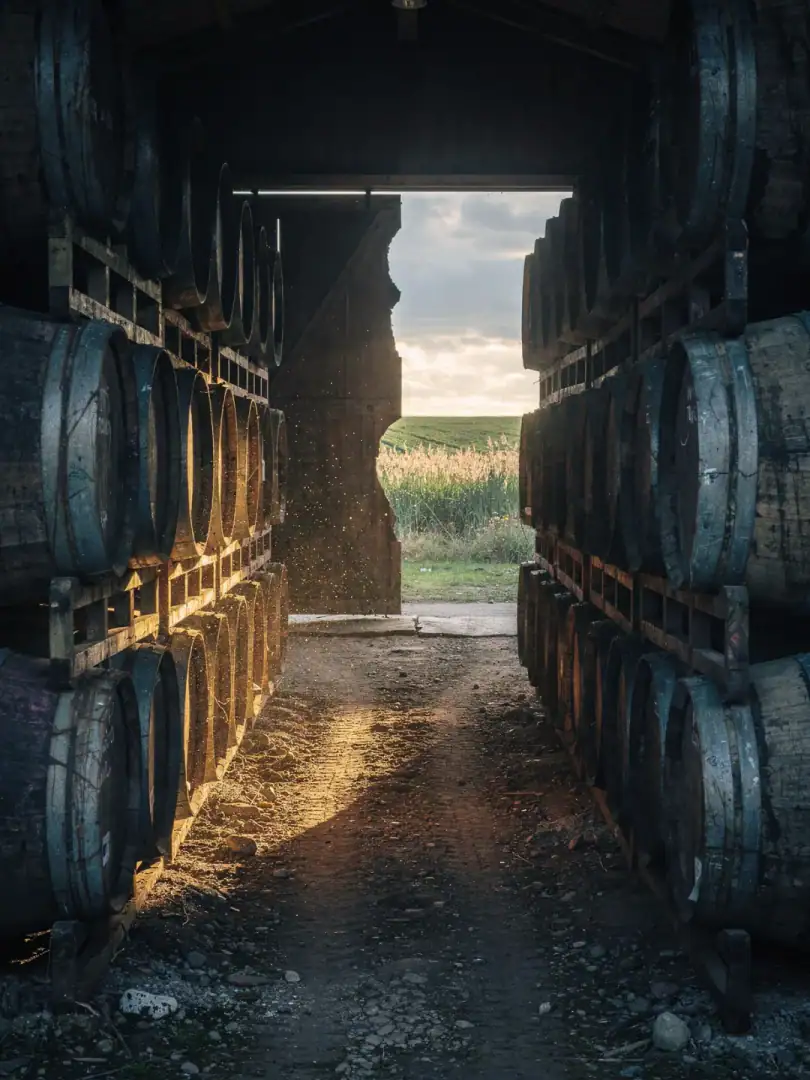
Warehouses by the Sea
Cask & Maturation
Five warehouses stand on the grounds at Stauning, none of them especially large, all within sight of the fields the grain comes from. Under EU law, whisky can only be called such once it has rested at least three years in an oak cask of no more than 700 liters, reaching a minimum of 40 percent ABV in the finished product. Denmark has no maturation law of its own; the rule applies EU-wide, and thus to every distillery in the country.
Used bourbon casks from America are the most common choice. Alongside these are new, unused casks made of American white oak, whose wood hasn't yet been softened by a first fill of whisky. The distillery also experiments with casks that previously held Cognac, Calvados, mezcal, Madeira, Moscatel, or vermouth, giving each bottling its own, often unexpected edge.
The maritime climate on the North Sea coast brings stronger seasonal swings than a mountain cellar would, but gentler ones than a true continental climate. On warm days the whisky breathes out through the cask wood, contracting again on cold nights. This lets it pick up color and aroma faster than whisky matured in cooler, drier locations, though more is lost to evaporation as the so-called Angel's Share than in a dry continental climate.
Braunstein in Køge matures its casks right by the harbor basin, where salty sea air seeps into the wood. The distillery deliberately highlights this effect in its single-cask bottlings. Fary Lochan, by contrast, matures its whisky in a cellar deep in the woods near Give, sheltered from wind but without the maritime influence the two coastal distilleries claim for themselves.