Twenty-Four Small Pots
Distilling
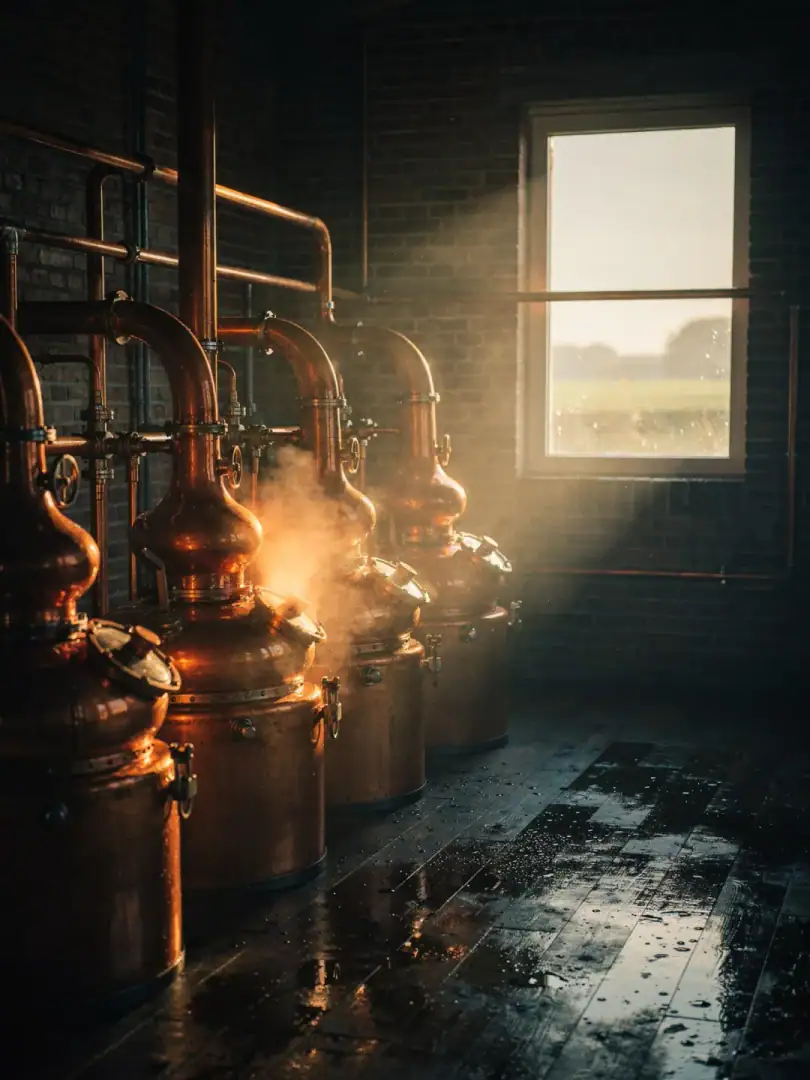
Where other distilleries work with two or three large stills, Stauning lines up 24 small copper pots in a row. Each is barely bigger than a beer keg for a village pub. This array of small stills makes it possible to distill different batches — peated and unpeated, from barley and from rye — separately. The setup doesn't need extensive cleaning between runs.
All the pots are direct-fired, meaning they're heated by an open flame from below rather than by internal steam coils, as is more common. The copper wall can reach temperatures of up to 650 degrees. Solid particles from the mash settle on this hot surface and lightly caramelize, giving the finished whisky more body and an almost creamy texture.
Distillation is done twice, as is typical in Scotland and Ireland. The first run separates pure alcohol from the solid mash. The second concentrates the spirit to drinking strength and separates the so-called middle cut, the heart of the distillate, from the undrinkable heads and tails. At Stauning, this cut is still made by hand by an experienced distiller, not by computer.
Braunstein in Køge chose a different path. In 2007, the distillery installed a hybrid still combining a copper pot with a five-plate column, now holding 1,250 liters per run. The column allows for a higher, more consistent alcohol content in a single pass. The method is closer to American bourbon distilling than to the classic Scottish double distillation.