Limestone Instead of Peat Bog
Malt & Peat
The Swabian Alb has never known the peat that Scottish island distilleries burn through. Instead of a bog, a thin layer of humus lies over hard limestone beneath the grain, too little organic material to ever form a peat deposit. Cut into the earth beneath the grain fields and you'll find limestone, not a peat layer.
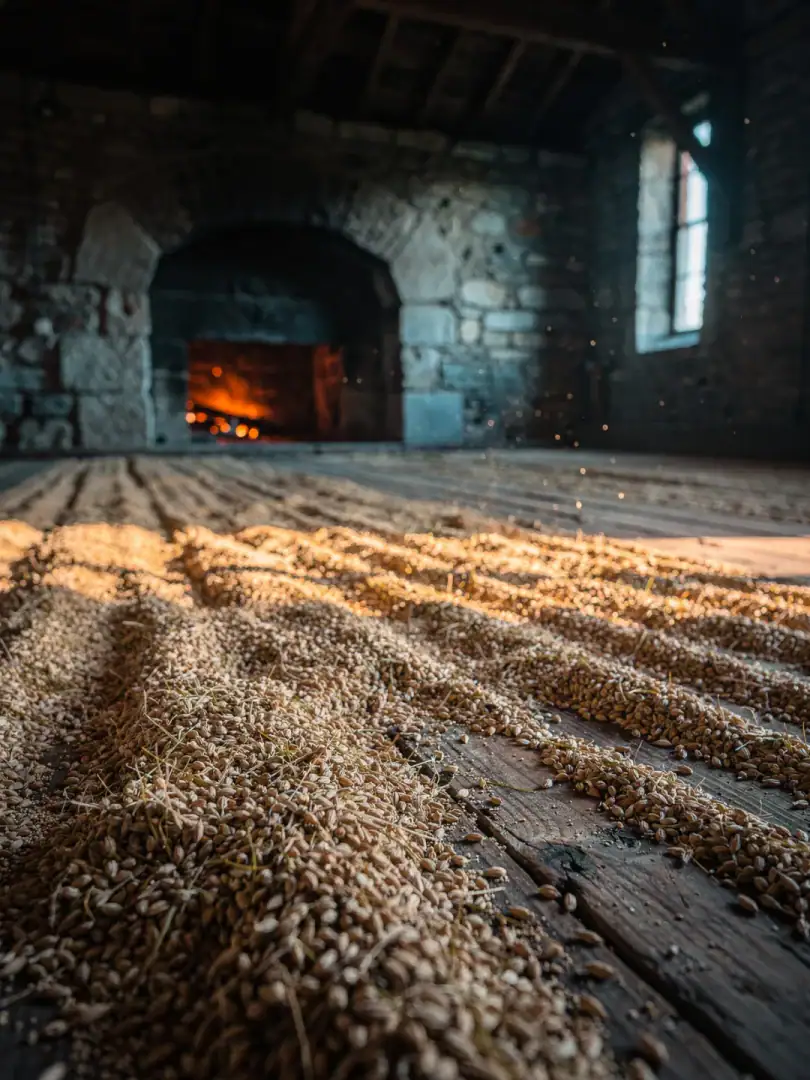
The malt on Finch's farm near Nellingen therefore comes from his own barley, with no smoke involved at all. After harvest, the grain is germinated and dried again to develop the enzymes that will later convert starch into sugar. Anyone looking for peat smoke here is looking in the wrong place.
In the Black Forest, things aren't quite so clear-cut everywhere. Alongside its unpeated bottlings, the Wild distillery in Gengenbach also releases a peated whisky, for which smoked malt is specially sourced, since the region itself has no peat bog. Smoke here is a deliberate stylistic choice, not a geographic necessity the way it is on Islay. Peat therefore remains an exception in the Black Forest, not a regional heritage the way it is in Scotland.
For most distilleries in the region, malting remains a matter of germination, kilning, and precise temperature control rather than fire and bog. That's exactly the difference from smoky regions: the character develops later, in the cask and in the choice of grain, rather than during the drying of the malt.
That's exactly why you won't find a ppm value in Finch's whisky, the figure peaty whiskies use to measure their smoke content. Without peat, there's simply nothing to measure. What counts on the Alb instead is the purity of the malt and patience during kilning, the careful drying of the germinated grain at a controlled temperature.
Thin, stony topsoil typical of the Alb plateau.
The root: The barley's roots reach the limestone beneath after just a few centimeters.