Limestone and Karst
Water & Climate
Roughly 145 to 200 million years ago, a warm sea covered the Alb near Nellingen. From the limestone shells of countless sea creatures grew the rock that still carries the plateau today: the White Jura.
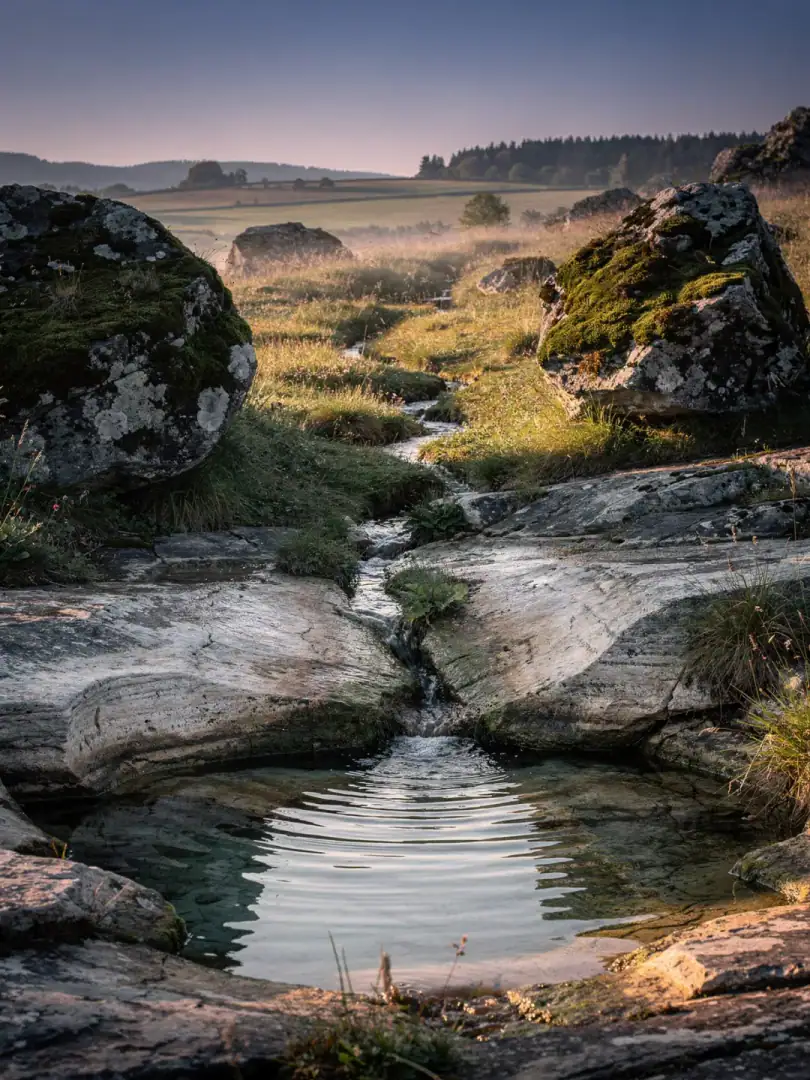
Limestone dissolves slowly in rainwater. Over thousands of years, water ate its way through cracks and fissures, creating one of the most cave-riddled landscapes in Germany. Surface rivers are rare on the Alb as a result; most of the water disappears straight into the ground and only resurfaces miles away, at karst springs.
This water is hard, rich in calcium, filtered through rock rather than peat. For the mash, that means a different starting material than in many other whisky regions, where soft, peat-tinted water is the norm. Anyone distilling on the Alb is therefore working from the start with harder, more mineral-rich water.
The Black Forest rests on different bedrock: granite and gneiss, crystalline rock quite unlike the limestone of the Alb. Dense forests there hold onto the rain, which falls far more generously than on the bare plateau above. The Kinzig Valley itself sits lower and milder than the ridges above it, giving the casks stored there a calmer climate. Rainwater seeping through granite stays softer than the lime-saturated water of the Alb.
Day and night temperatures swing more sharply on the Alb's high plateau than in the valley, because the thin air up there cools faster. It's exactly this back-and-forth that makes a cask work: breathing whisky into the wood and back out again, changing the contents a little with every cycle.