Malt instead of peat
Malt & Peat
Bogs in Bavaria are largely protected as nature reserves. Peat, as a result, is virtually absent from Bavarian malthouses. Anyone making whisky here kilns their malt without peat smoke, unlike on the Scottish islands.
The malt itself often comes from the neighborhood. Weyermann in Bamberg has been malting since 1879. Today, the family-owned company supplies breweries and distilleries far beyond Franconia, with around 260 employees across several sites. What began as a hand-operated roasting drum on one of Bamberg's seven hills has grown into one of Europe's best-known specialty malthouses.
Bamberg and Franconian Switzerland still have their own smoking tradition, just not with peat. For the city's famous Rauchbier, malt is kilned over beech wood rather than peat cuttings. Whisky malt is usually untouched by this. But it shows just how deeply kilning with fire is rooted in Franconian brewing culture, only with wood smoke instead of peat smoke.
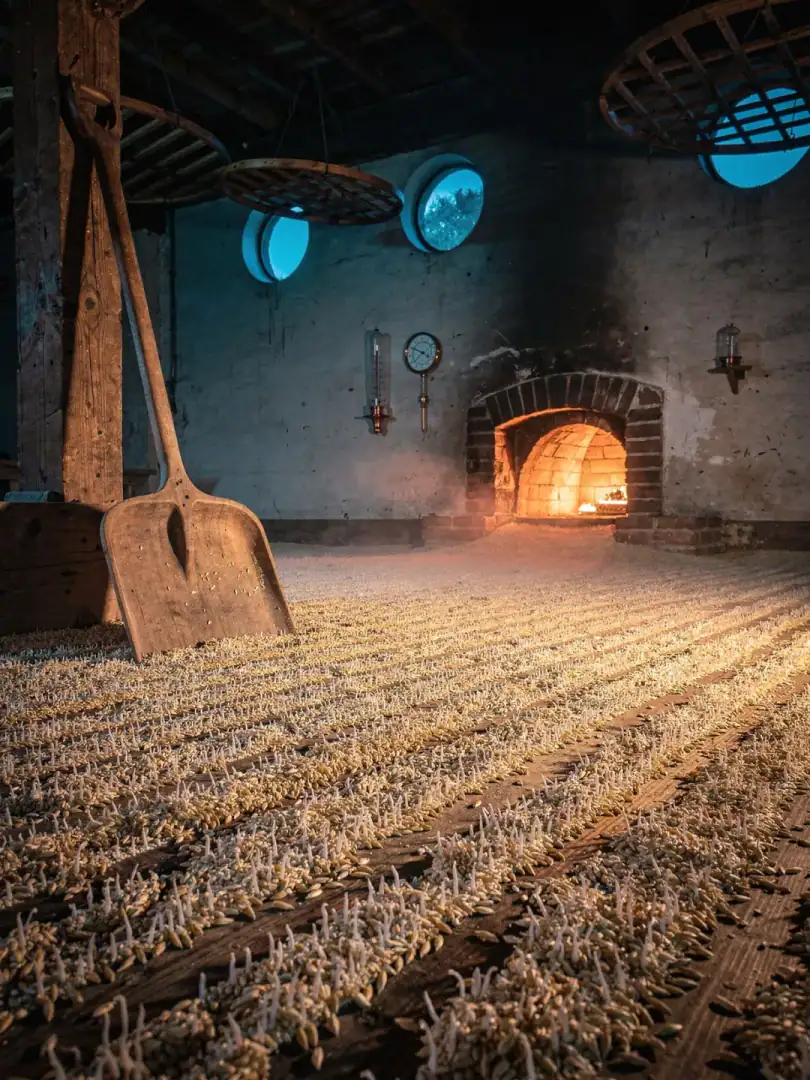
During malting, the barley is soaked until it germinates. At exactly this moment, the maltsters halt the process, usually with warm air rather than smoke. This protects the enzymes that later break down the starch during mashing. As a result, the eventual distillate tastes purely of grain and cask, rather than fire.
Beneath the barley itself often lies the Gäuboden, Bavaria's best-known grain-growing region between Straubing and Regensburg. There, thick, ice-age loess sits over gravel that holds water and produces plump, starch-rich kernels. These soils, not peat bogs, are the foundation on which Bavarian whisky grows.
Humus-rich soil in which the malting barley takes root
The root: Supplies the barley with nutrients for plump, starch-rich kernels