Open flame, twice over
Distillation
Two very different styles emerge when you place Brittany's stills side by side. Warenghem in Lannion favours classic scale: the wash still holds 6,000 litres, the smaller spirit still, in which the actual drinking spirit is produced, holds 3,500 litres, both run through twice, just as most Scotch single malts are.
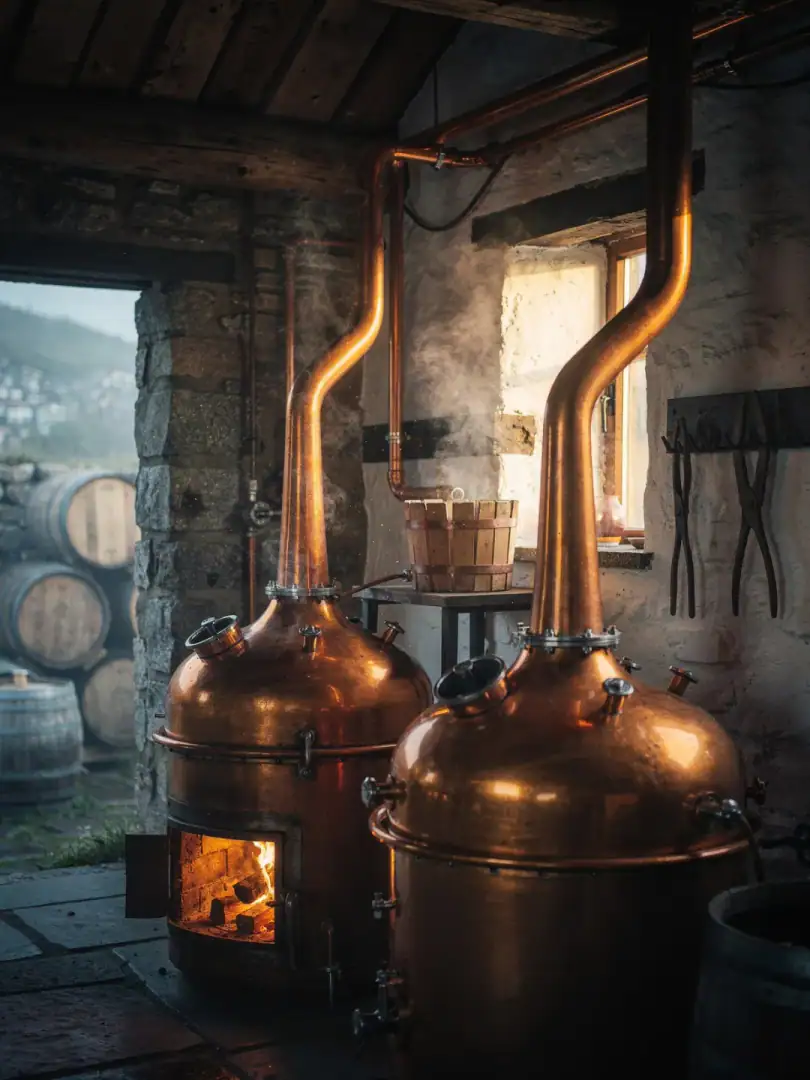
Glann ar Mor in Pleubian takes the opposite path: small and fired directly by open flame. The distillery works with just two copper stills of 1,300 and 900 litres, onion-shaped and heated directly with fire rather than steam coils. The first distillation ran on 12 June 2005.
Open flame has long since become rare in Scotland, where most distilleries now heat with steam because temperature is easier to control that way. Direct fire, by contrast, occasionally scorches a little mash at the bottom of the still, creating extra roasted notes, a deliberately accepted risk for greater complexity in the finished spirit.
The Distillerie des Menhirs faces a challenge of its own: its buckwheat mash is thicker than a barley mash and harder to move through the still. Even so, the distillery sticks to the classic double-distillation method familiar from Scotland, just using a raw material no Scottish distillery has ever touched.
In the end, all three arrive at the same step: the cut, meaning the separation of the foreshots, the heart, and the feints. Only the heart, the middle run, goes into the cask; the rest is discarded or fed back into the next run. How tightly this cut is drawn later determines the sharpness and purity found in the glass.