The short answer
Both spellings are common. In Scotland it's usually spelled Whisky, in Ireland often Whiskey. The extra letter says nothing about how it's made. That's governed by the rules of the respective category.

Spelling is not style
Even within a single country there are different traditions, and every brand makes its own choice. Whisky or Whiskey alone tells you neither smoke nor sweetness. Nor does the spelling say anything about age or quality.
It tells you something about a brand's origin and house custom, nothing more. Behind it lie tradition and a decision about labeling. It's not a production rule. What ultimately ends up in the glass is governed by the requirements of the respective category, and those don't hinge on an e.
In practice, that means: two bottles with the same spelling can taste completely different. Two with different spellings can be surprisingly similar. If you tell yourself, I like the one with the e, you haven't really learned anything useful. More useful is the category, and remembering which flavors you actually enjoyed.
Try both spellings when searching
If you're looking for a specific bottle online, take the name exactly as it appears on the label. For general questions, either spelling works. The exact category gives you more guidance: Bourbon, Single Malt Scotch, or another origin.
For your own collection, I'd keep the original name and track your tasting notes separately. With an e is not a useful preference. Not smoky, more fruity is. Even in a blind comparison, the goal isn't to guess a letter. It's to find out which impression you actually like.
When typing into a search box, it's worth trying both variants if you're unsure. Some shops only carry the form printed on the bottle, others match automatically. The most reliable way to find a specific bottling is by the full name on the label, plus the category.
For notes, a simple grid is enough: name, origin, category, plus two or three keywords about the impression. After ten entries, you'll start seeing patterns that are more useful for your next purchase than any spelling. You'll also be able to tell whether you keep sticking to the same corner or are actually trying something new.
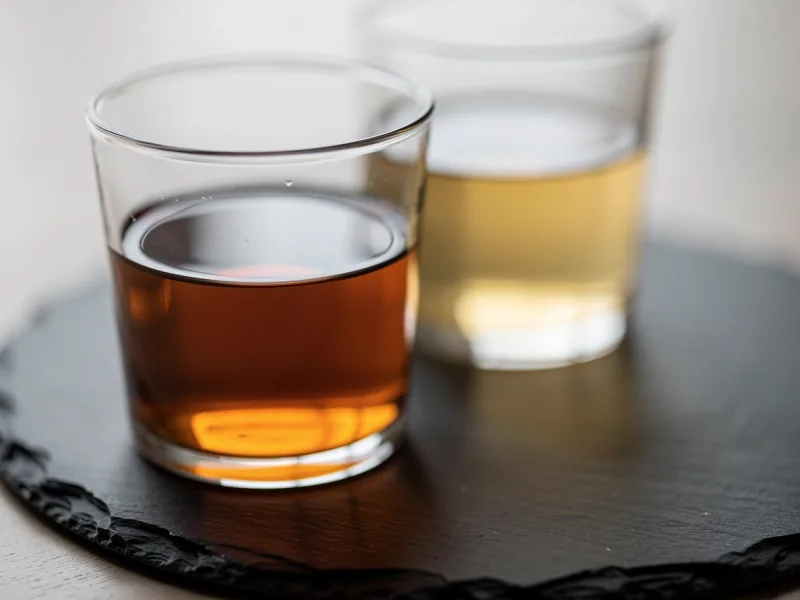
Check spelling and production separately
No matter which spelling is on the bottle, the useful information is always the same: origin and full category.
The letter is part of the name and stays there. You get further with the two lines beneath it: where the bottle comes from and what the full category is called. Only from that do you know what to expect in the glass. An unusual brand spelling doesn't change that; it's simply a decision made by the brand.
| You read … | Then also check … |
|---|---|
| Whisky | Origin and full category |
| Whiskey | Origin and full category |
| A deviating brand spelling | The spelling alone is not a production rule |
The missing “e” says nothing about quality
The most persistent idea is that the extra e stands for a particular method of production, or even a higher tier. It doesn't. Whether a bottle is smoky or mild, young or long-aged, you can't tell from that either. Those characteristics are in the fine print, or follow from the category.
A second misconception: that the spelling reliably indicates a country. The usual association often holds true. But there are brands that do it differently, and different traditions exist even within one country. Anyone who builds an assumption about origin on that single letter will eventually be wrong.
What to go by in the shop
Pick up the bottle and look for the category name. Bourbon or Single Malt Scotch tells you far more about the character to expect than the word before it. After that, it's worth checking the origin and, if given, the age statement.
If you're unsure, compare two bottles from the same category but different origins. That comparison actually teaches you something. Pitting Whisky against Whiskey, on the other hand, gets you nowhere. All you're comparing then are two arbitrary products that have nothing in common except the sequence of letters.