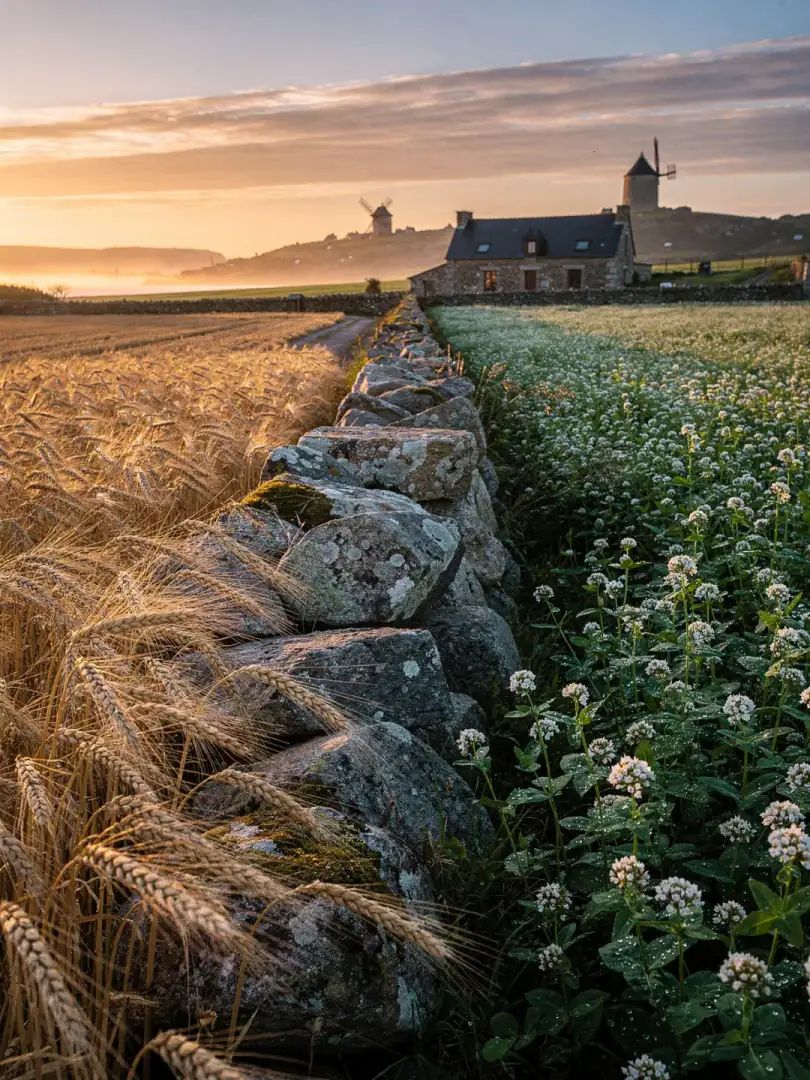
Barley and buckwheat
Grain
Warenghem in Lannion malts Breton barley and mashes it with water from its own Rest-Avel spring. Unlike many major Scotch brands, Armorik actually sources its grain from its own region.
The Distillerie des Menhirs in Plomelin takes a completely different approach. It forgoes barley entirely and brews its Eddu whisky from buckwheat, known in Breton as blé noir. Botanically, buckwheat isn't a grain at all but a member of the knotweed family. In Brittany, however, it has been treated as one for centuries, above all for the galette, the region's buckwheat crêpe.
A mash made from buckwheat and water becomes thicker than one made from barley. That makes processing more difficult at the distillery, and the yield of pure alcohol comes out lower. The Distillerie des Menhirs accepts this trade-off. Distilling whisky from buckwheat costs five to six times as much as distilling whisky from the same amount of barley.
Since 2014, the Geographical Indication Whisky de Bretagne has protected the origin without prescribing any particular type of grain. Whisky made from any kind of grain is permitted. It must simply be brewed and distilled within historical Brittany and aged for at least three years in the region's oceanic climate.
For comparison: the Scotch Whisky Regulations require malted barley for a single malt without exception, ruling out any other grain. Brittany knows no such restriction. This very openness is what made the buckwheat whisky from Plomelin possible in the first place. In Scotland, Eddu could never exist as a single malt.