Atlantic and granite
Water & Climate
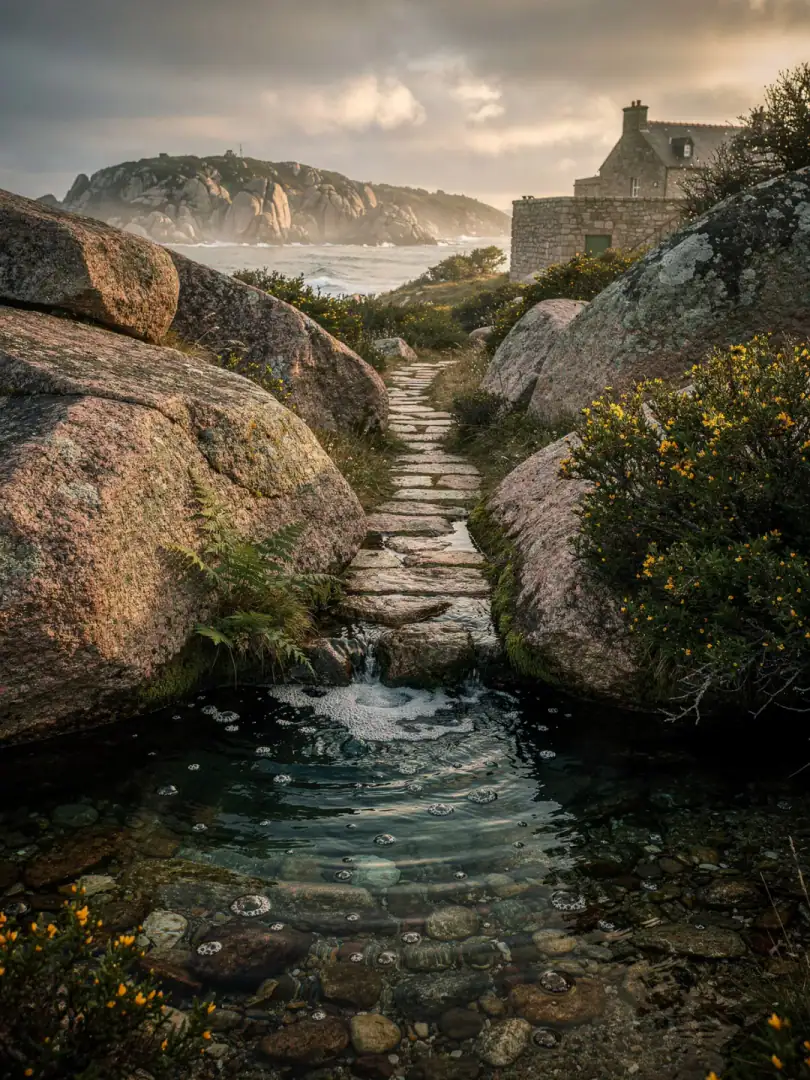
Right next to the Warenghem distillery in Lannion lies the Rest-Avel spring. Its water rises to the surface through pink granite, the same rock that gives the coastline around Lannion its name: Côte de Granit Rose.
Granite releases hardly any lime into the water, unlike the limestone through which Scottish brewing water often seeps elsewhere. The result is soft water. It reacts only weakly with the enzymes in the malt during mashing, giving fermentation free rein.
Above ground, the Atlantic governs the climate: mild in winter, rarely hot in summer, almost always humid, with wind and rain blowing in from the sea. For the warehouses, this means constantly shifting humidity, quite unlike the drier continental climate found further inland in France.
This humidity speeds up maturation in the cask compared to a drier warehouse. The whisky loses alcohol to the air faster than it loses water, becoming milder and rounder as a result. It also takes on colour more quickly, ranging from pale yellow to dark mahogany.
Near the coast, another factor comes into play: damp, salty sea air seeps into the warehouses. There's no fixed measure in Brittany for how strongly this shapes the whisky. On Islay, by contrast, coastal location and salinity are often explicitly promoted. Breton distilleries tend to let the casks speak for themselves.
Anyone travelling through the region often feels the climate immediately: even on seemingly sunny days, a fine drizzle frequently hangs in the air, known in Brittany as crachin. It's exactly this microclimate that accompanies the casks throughout their entire maturation.