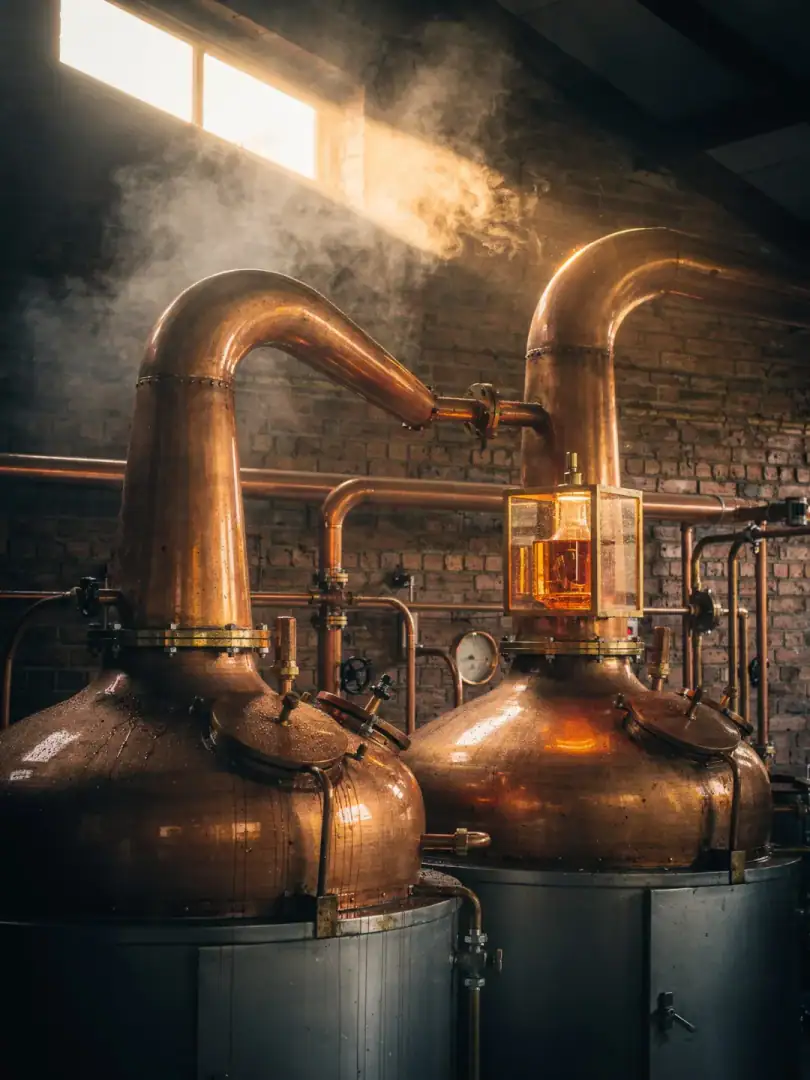
Copper instead of column
Distillation
Copper instead of steel, handcraft instead of continuous operation: this is what sets Amrut and Paul John apart from the rest of India's whisky industry. Most Indian whisky comes from the column still, which runs continuously and draws an almost pure, flavourless alcohol from fermented molasses. Amrut and Paul John, by contrast, distil like Scottish malt distilleries: twice, in copper pot stills.
For the Indian Single Malt category, the column still is now explicitly banned. The Indian Malt Whisky Association's rules mandate copper pot stills instead. Copper binds unwanted sulphur compounds from the mash. This effect matters especially in India, where fermentation runs fast and hot. At temperatures often above 30 degrees Celsius, the yeast works far more hastily than it would in cool Scotland.
The first distillation crudely separates alcohol from the rest of the mash. The second distillation determines the character. Here too, the classic cut into heads, hearts, and tails applies. Only in India, the clock runs faster: what takes hours in Scotland is often over more quickly under tropical heat. Distillers must therefore watch the transition between fractions with particular care.
What emerges is a raw spirit that turns out spicier and sharper in Bangalore, rounder and fruitier in Goa. Both distilleries work with very similar technique. The difference lies before the still even comes into play, in the barley, the water, and how the yeast is managed. The still itself only shapes what was already set in motion beforehand.