Angels drink faster
Cask & Maturation
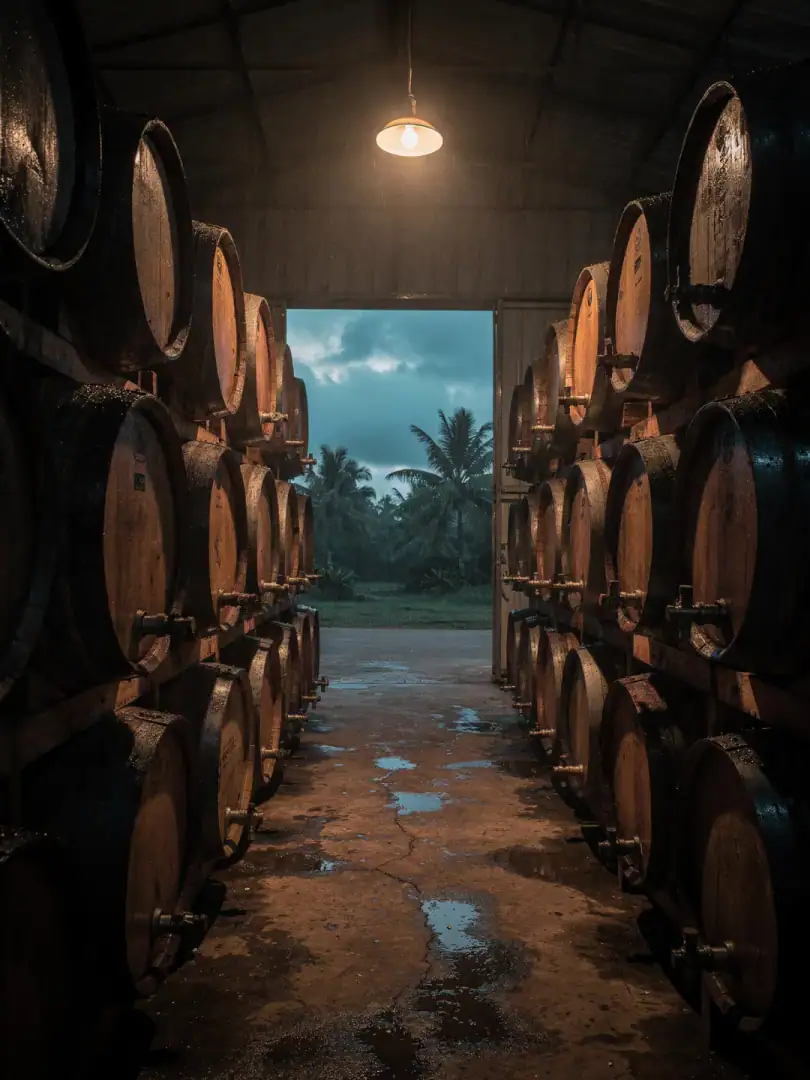
Twelve years in Speyside, four in Bangalore: the whiskies can still taste comparably mature. The reason is the angel's share, which takes on entirely different proportions here. A cask in a Scottish warehouse loses a leisurely two percent of its contents to the air each year. In India, by contrast, ten to twelve percent evaporates, and some casks lose even more. What takes twelve years in Scotland can be achieved in Bangalore or Goa in four to five years. Amrut's master blender Surinder Kumar puts it succinctly: one year of cask maturation in India is roughly equivalent to three years in Scotland.
Paul John relies almost exclusively on charred American oak casks that previously held bourbon. The charcoal-filter aroma from the charred cask interior migrates into the whisky especially quickly in Goa's heat, along with vanilla and coconut notes from the wood. Amrut uses a broader range of casks, from ex-bourbon to sherry and port casks for later finishes, achieving a denser, spicier spectrum as a result.
The warehouses themselves do little to keep things calm. In Bangalore, temperatures swing between dry daytime heat and cooler nights on the plateau. In Goa, by contrast, the air stays humid and warm almost year-round thanks to the proximity to the sea. Both climates force cask and whisky together fast, rather than letting them slowly converge over decades as in Scotland.
Because maturation moves so quickly, both distilleries typically look for their 'sweet spot' somewhere between four and eight years. Beyond that, too much wood tips into the whisky in many casks. A twenty-year-old whisky from Bangalore or Goa wouldn't be more mature than one from anywhere else. It would, above all, be one thing: hollow.