Peat from Scotland
Malt & Peat
There are no peat bogs in India, neither on the Bangalore plateau nor along the Goan coast. What grows right outside the door in Scotland has to be imported here if a whisky is meant to taste smoky at all. Neither distillery malts its own barley either. The grain arrives already malted from commercial maltsters. A traditional malting floor, as some Scottish houses still maintain, is nowhere to be found here.
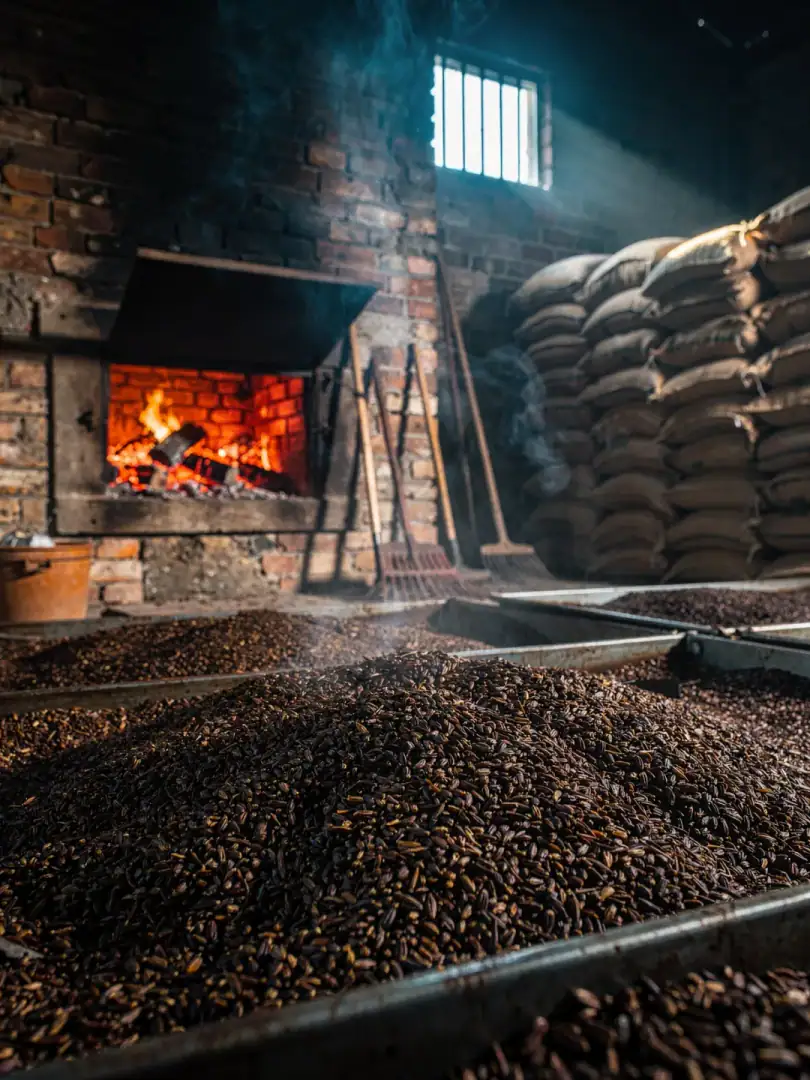
For its Peated Single Malt, Amrut has Scottish barley malted at Baird's Malt in Inverness. There it's smoked to 24 ppm, the internationally used measure for phenol content in the finished malt. Only afterwards does the finished malt travel the long way back to Bangalore. There it becomes a whisky with notes of citrus, black pepper, and campfire smoke, noticeably milder than an Islay, but unmistakably present.
Paul John takes a similar path. For its peated bottlings, the distillery sources smoked malt from Scotland, peated on the islands. The bulk of production, however, relies on unpeated Indian six-row barley. Smoke thus remains the exception rather than the rule, a tool for select bottlings rather than the house's core character.
A distinct malting tradition, of the kind that defines Speyside or Islay, could therefore never take hold in Bangalore or Goa. What matters here isn't the peat in the ground. What counts is the barley itself and the climate it encounters after distillation. Smoke remains an ingredient sourced from afar, not a legacy of the local soil as it is on Islay.
Fine, river-deposited soil in Punjab and Haryana, where barley grows quickly during the cool winter half-year.
The root: This rapid growth is partly responsible for the smaller, protein-rich grains of Indian six-row barley.