Monsoon and plateau
Water & Climate
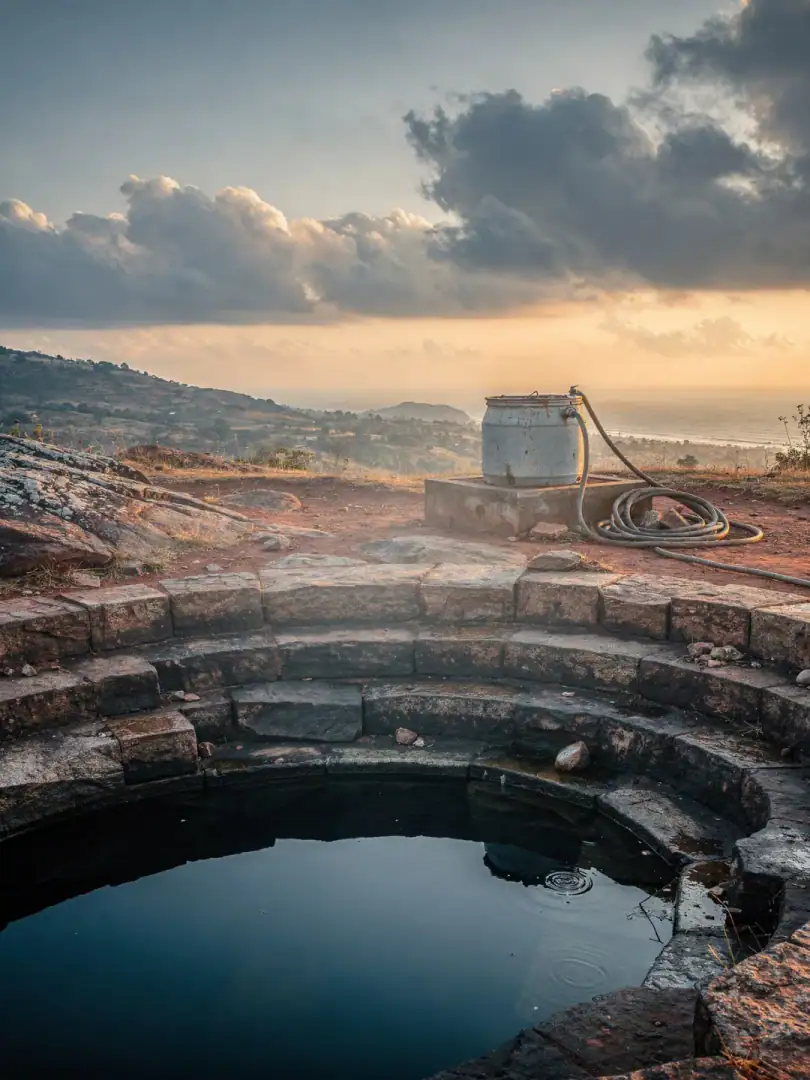
Amrut's brewing water first falls as rain in the Himalayas, long before it ever meets malted barley in Bangalore. Collected from a well in northern India, it travels the same route as the barley, trucked vast distances across the country. Only on the Deccan Plateau, around 900 metres above sea level, do water and malt finally come together. No river or nearby spring spares the distillery this detour. Every litre travels almost as far as the barley itself.
Beneath Bangalore lies one of the oldest rock formations on Earth, known as Peninsular Gneiss. This hard rock lets rainwater barely seep through, so wells in the region yield hard, mineral-rich water. Goa, further southwest along the coast, sits on entirely different ground: red laterite rock, washed by the monsoon every year. This porous, iron-rich stone lets water pass through far more easily than the granite up north. As a result, Goa's water tastes softer, with fewer minerals than that of the plateau.
The Mandovi River runs through Goa, fed by the southwest monsoon that hits the coast between June and September, keeping the air dripping wet for weeks on end. Paul John's whisky matures in this humidity, quite unlike the drier climate on the Bangalore plateau, where the air is hot but noticeably less humid. For the distillery, this means two very distinct seasons. During the wet, sweltering months, the air barely moves. During the drier months, a sea breeze sweeps across the warehouse instead.
Both climate zones push whisky to a pace unknown in Scotland. Where a cask in Speyside leisurely deepens in colour, in both Bangalore and Goa a far greater share of the contents evaporates each year, driven by heat and, on the coast, by the humid sea air as well. Scottish distillers speak in years; Indian ones speak in seasons. What begins with the water ends with the cask. Two climate zones, one country, two entirely different whiskies.