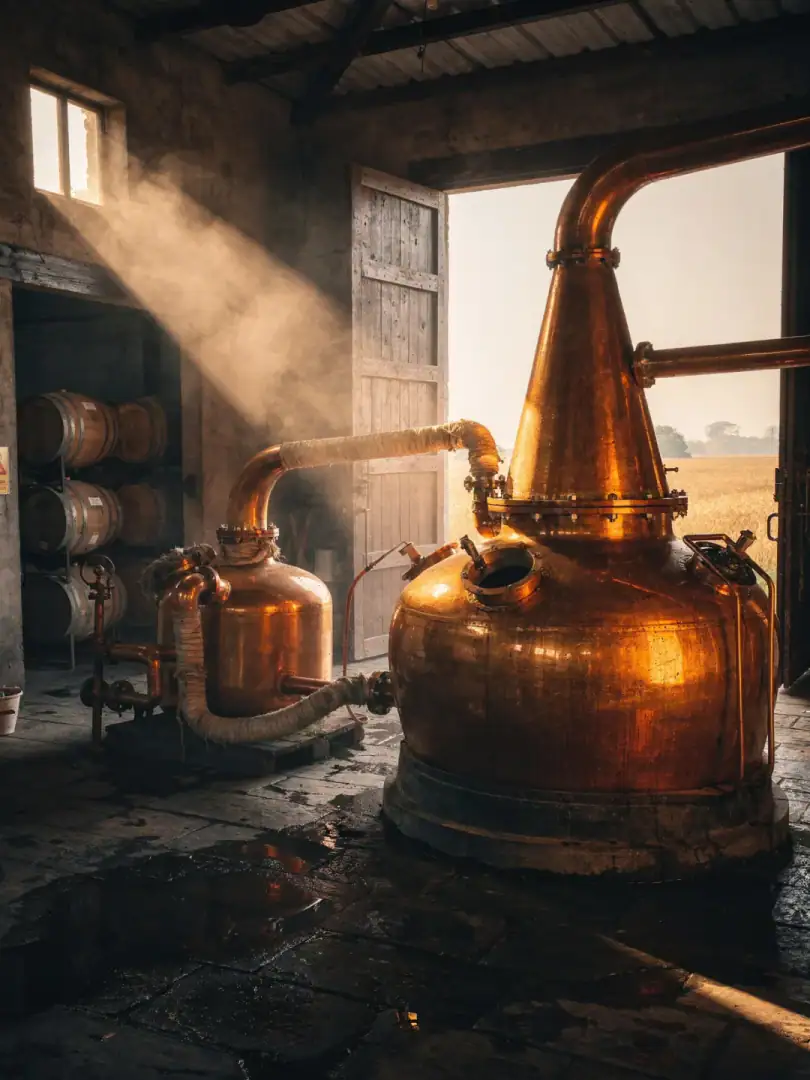
Copper since 2012
Distillation
At Indri, the stills have been made of copper since the distillery installed them in 2012. Just as in Scotland, the mash passes through the still twice: once for a rough separation of alcohol and water, a second time to draw out character and purity. Copper binds unwanted sulphur notes along the way, which would otherwise linger in the finished whisky and spoil the flavour. The stills are pot-bellied in shape, typical of Scottish malt distilleries, only the heat surrounding them is entirely different.
Unusually, Piccadily doesn't produce its malt whisky at a single site. Distillation happens simultaneously at three locations: in Indri itself, in nearby Patiala in Punjab, and in Bawal in Haryana. Only afterwards do the casks come back together for maturation, a division of labour that's the exception rather than the rule in the world of single malts.
The casks themselves are partly made in-house too. Piccadily runs its own cooperage right at the distillery, allowing precise control over how heavily a cask is charred on the inside before the young whisky goes in. That, in turn, determines how much vanilla, caramel and roasted character the wood will later give to the whisky.
Rampur and Godawan follow the same basic principle of copper pot and double distillation, recognised worldwide as a requirement for the single malt designation. The difference lies less in the still's technique than in the climate around it. The same still shape produces a different new-make spirit in the desert heat near Alwar than it does in the more temperate Karnal.