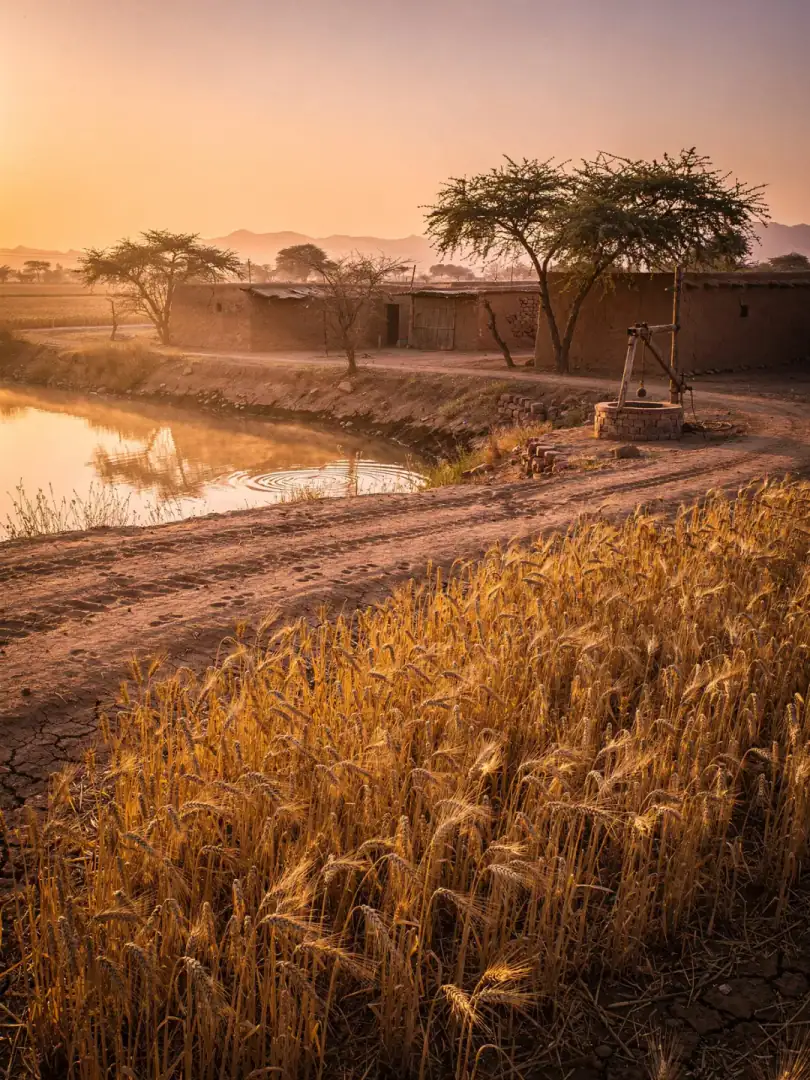
Six-row barley
Grain
When people in Scotland say barley, they almost always mean two-row varieties, where two rows of grain sit on the ear. In North India it's the other way around: Indri, Rampur and Godawan all rely on six-row barley, grown in Rajasthan, Haryana, Punjab and neighbouring Uttarakhand. The ear carries more grains, but each one has less starch and more protein than its two-row relative.
You can taste that difference later in the glass. More protein and fibre give the mash more body and carry fruity, slightly tannic notes through distillation. Godawan sources its barley directly from the fields around Alwar, where enough well and canal irrigation remains to sustain cultivation despite the dryness. Indri has its malt shipped in specially from Rajasthan, even though the distillery itself sits in Haryana.
Legally, none of this is required, it's purely a choice. India's Alcoholic Beverages Rules of 2018 also allow whisky made from pure neutral spirit, distilled from sugarcane molasses instead of grain. That's exactly the path most brands in the country take: cheap molasses alcohol, dressed up with colourings and flavourings to taste like whisky. Rampur, Indri and Godawan skip that entirely and mash only from crushed, malted grain.
Corn and rye play virtually no role here, unlike in the US or Canada. The region sticks with its barley because it grows right on the doorstep, and because the distilleries are keen to call their whisky single malt, a term that in any case only permits malted grain of a single variety. The short haul from the fields of Rajasthan to the stills is more than just convenient: it's part of the sales pitch Godawan and Indri make abroad.