Extremes instead of a middle ground
Water & Climate
Few whisky regions in the world see temperature swings as extreme as North India. In Haryana, home to Indri, icy winters alternate with brutally hot summers, often within just a few months. Uttar Pradesh, home to Rampur, is regarded by connoisseurs as the exact opposite of the humid, warm south: cold winters, hot summers, hardly any middle ground.
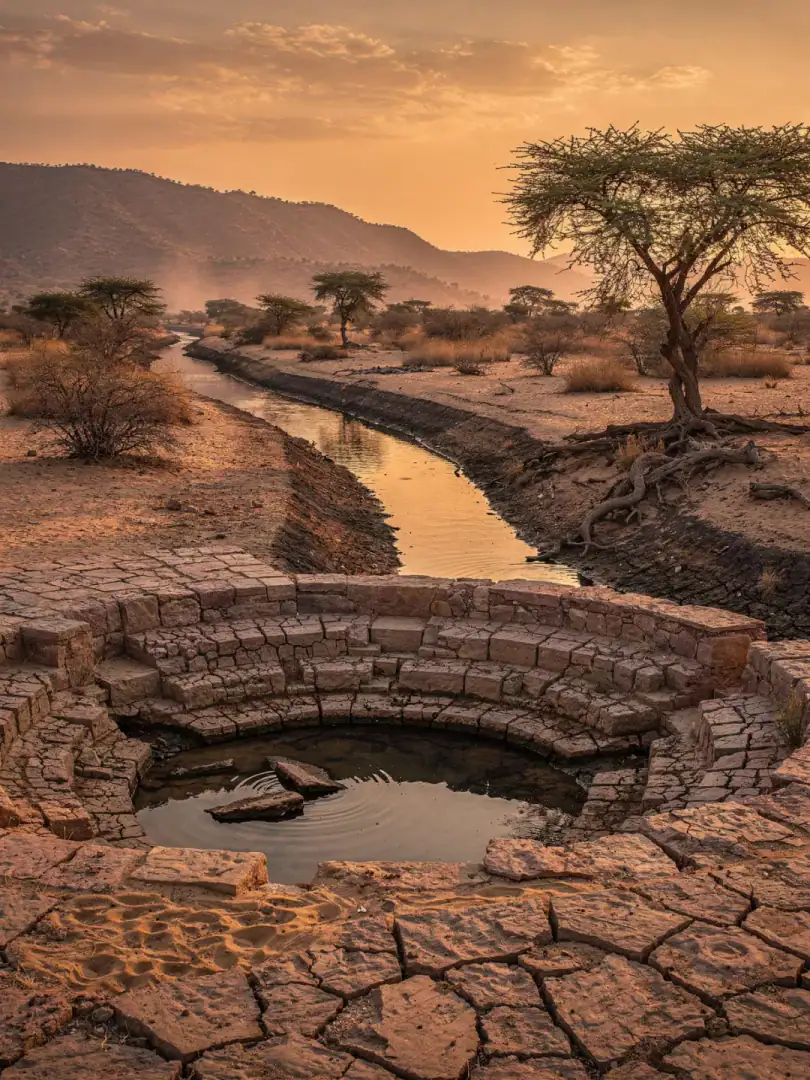
Godawan in Alwar, Rajasthan, has it hardest of all. There the thermometer regularly climbs past 38 degrees Celsius, and the desert air is so dry that moisture is practically torn from the cask rather than gently evaporating. For the barley in the fields, that means: without irrigation from wells and canals, nothing here would grow ripe enough to become malt.
This heat doesn't just kick in once the whisky's in the bottle, it starts right at distillation. Water needed for mashing and cooling comes from the surrounding area at all three distilleries, and it has to hold up even in summer heat without warming uncontrollably. What's a minor concern in Scotland becomes a daily challenge for the distillers here.
For maturation, the heat is the real engine. It drives the young whisky in and out of the cask, pressing it deep into the wood and back out again, much faster than in a cool Scottish warehouse. What takes a decade there, a cask in Alwar or Karnal often achieves in a fraction of the time. In return, it also loses far more content to the air.