Triple Through Copper
Distillation
Three runs instead of two: that's what sets most Dublin and Leinster whiskeys apart from their Scottish relatives. Triple distillation makes the raw spirit lighter and purer, since the copper in the stills binds unwanted sulfur notes three times over instead of twice.
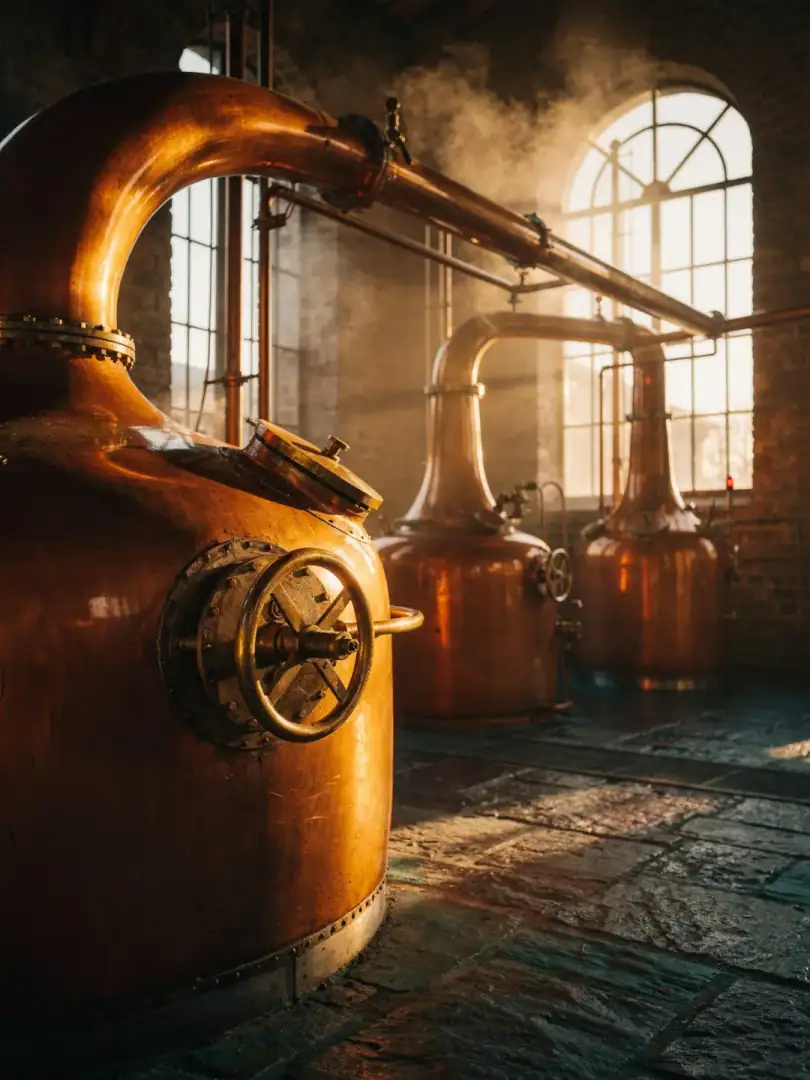
At Teeling in Newmarket, three copper pot stills carry on the old Dublin tradition of triple distillation. They're named Wash Still, Feints Still, and Spirit Still, each with its own role in the process. Only the final, narrowest cut from the Spirit Still goes into the cask.
The invention that shaped the other side of Irish whiskey came, of all places, from Dublin. Aeneas Coffey had once worked as a customs official and ran the Dock Distillery in the city. In 1830, he patented his column still. Scottish and English distillers embraced the invention enthusiastically; Irish distillers held out for a long time, out of pride in their own copper pot stills.
A counterpart to that modern technology still stands in Kilbeggan: a copper pot still dating from the early 19th century. It came back into operation in 2007, after the distillery had shut its doors in 1954. It's considered the oldest working pot still in the world and is still used today for small special-edition releases.
So two eras stand side by side: the youthful precision of Teeling in the city, and the artisanal patience of Kilbeggan in the countryside. Both share the same underlying faith in copper.
For the grain component in blends like Tullamore D.E.W., a column still comes into play. It runs continuously, rather than in individual batches like the pot stills. This continuous method yields a lighter, more neutral spirit that rounds out the spicier notes of the pot still in the finished blend. So two completely different distilling techniques meet within a single bottle.