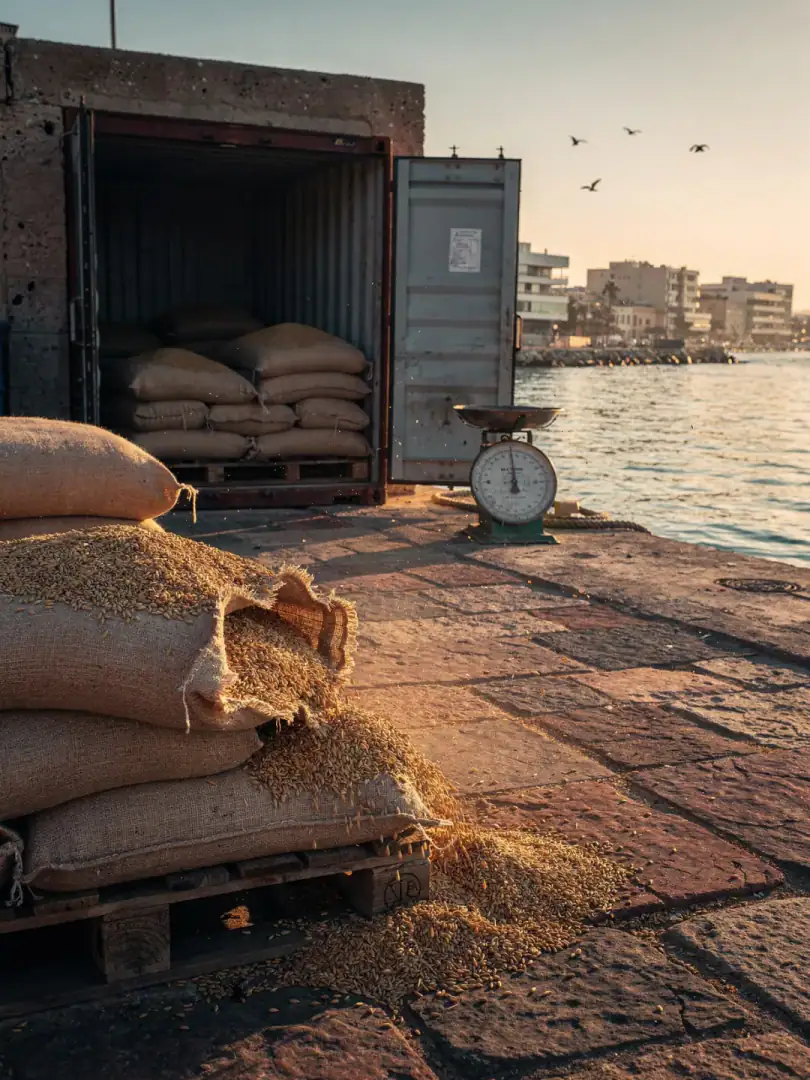
Barley from Britain
Grain
M&H doesn't start its whisky in a field in Galilee, but with a shipping container from England. The distillery sources its malted barley from British malthouse Muntons, mostly the two-row variety Concerto, prized for its high sugar yield and also popular with many Scottish distilleries. Growing and malting, then, don't happen in Israel, since the country lacks both suitable brewing barley and a malthouse geared for whisky production. Israel only contributes its share once brewing, distilling, and maturing begin.
For each batch, a ton of milled malt goes into the mash tun with 6,000 liters of water, twice a day. M&H brews this way, in small, successive batches rather than one large single run, as many Scottish distilleries do. Malt and water don't meet one after another but simultaneously in the air, a technique that traces back to Jim Swan. It draws sugar out of the malt faster and more evenly.
Only malted barley is used for flavor, no corn, no rye, no additives. That makes every drop from Tel Aviv a single malt in the classic sense, even though Israel has no law protecting the term. M&H nonetheless voluntarily follows the Scottish rule of at least three years of cask maturation.
After mashing, the wort ferments for sixty to seventy-two hours in six vats, using a dry yeast selected specifically for whisky. The result is a fruity, almost grassy wash reminiscent of stone fruit, sweeter and lighter than many Scottish counterparts. Twice a year, the same setup runs with peated malt instead. The next section has more on that.