Kettles and Columns
Distillation
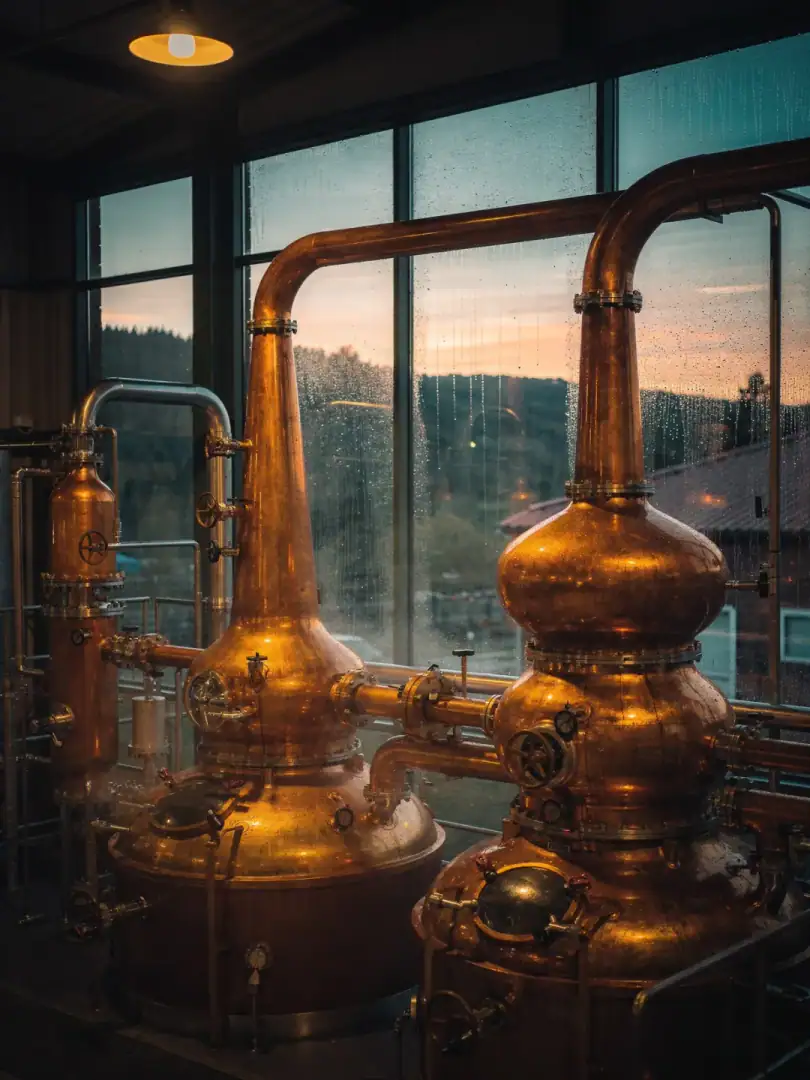
Two very different kettles stand under one roof at Miyagikyo. The copper pot stills for malt whisky have a round, bulging shape. Above the bulge sits a second, smaller ring. This ring sends vapors back down into the still, making the whisky lighter and fruitier.
Alongside these, Miyagikyo distills using Coffey stills, tall column apparatuses. Inside them, vapor rises continuously through multiple plates, rather than in batches as with the pot stills. Originally from Scotland, they've been in use within the Nikka group since the 1960s. Today at Miyagikyo they process mainly corn into mild grain whisky.
In Koriyama, whisky moves through the equipment in a more artisanal way. Sasanokawa's Asaka Distillery mashes in a 1,700-liter vessel. Fermentation takes place in five vessels made of Douglas fir. Distillation happens twice in copper pot stills from Miyake—a wash still holding 2,000 liters and a spirit still holding 1,000 liters. Both are heated indirectly with steam rather than an open flame.
The size difference is enormous. Miyagikyo ranks among Japan's larger malt distilleries, while Asaka, with its small kettles, remains an artisanal operation. What both share is the middle cut—cutting away the heads and tails during the second distillation. Only the pure heart of the run ends up in the cask; everything else goes back into the next distillation run.
So the region produces two very different answers to the same question. How much copper, how much reflux, how much handwork does good whisky need? Miyagikyo relies on technology and scale, Asaka on small batches and Douglas fir. In the end, both show in the glass which kettle the whisky came from.