Granite filters water
Water & Climate
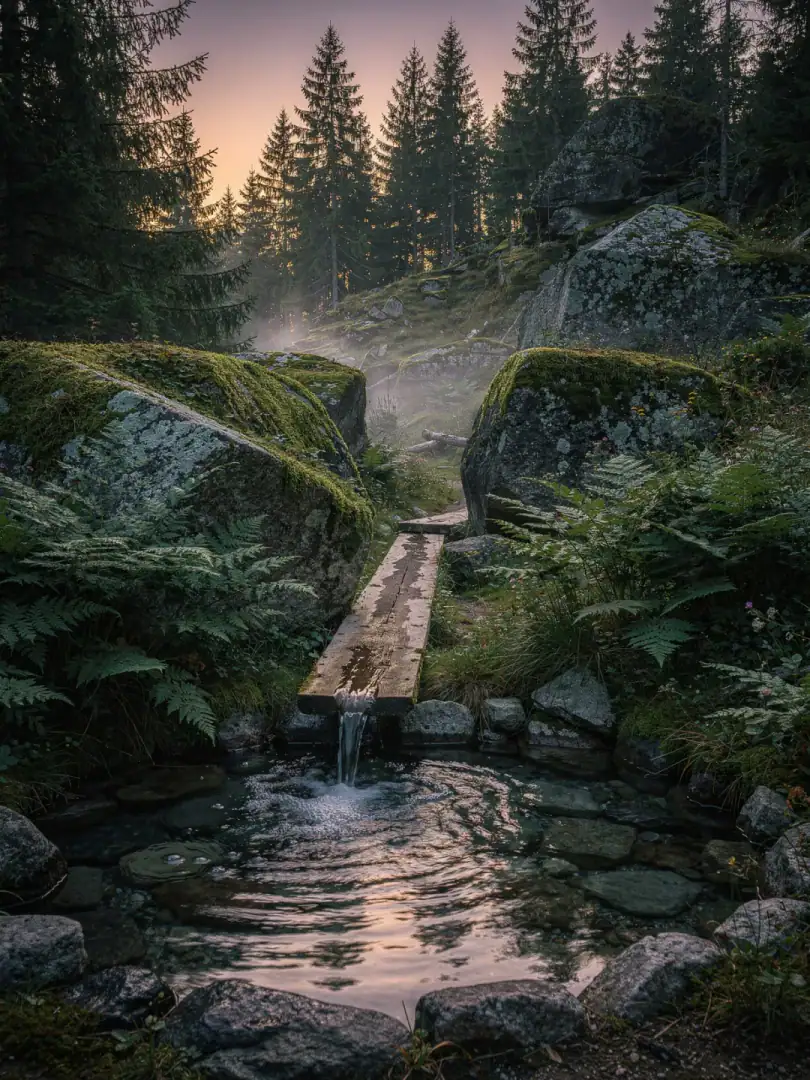
Water that seeps through granite carries almost nothing of the rock with it. Unlike limestone, which dissolves slowly and releases minerals into the groundwater, granite remains nearly insoluble. This is exactly what shapes the water from the Roggenreith spring, which supplies the entire needs of the distillery. It is remarkably soft, with a hardness level of only about 2 degrees German hardness.
Soft water behaves differently in the mash than hard water. It dissolves the enzymes in the malt more evenly. At the same time, it barely reacts with the tannins from the grain husk and wood. It gives the yeast more room during fermentation, since no minerals slow the process down. Many Scottish distilleries in granite landscapes like Speyside swear by their springs for the very same reason.
The Waldviertel lies on the Bohemian Massif, one of the oldest rock formations in Central Europe. Granite and gneiss formed here during the last major mountain-building period around 300 million years ago. Rivers like the Kamp and the Thaya have since carved their way into this hard rock rather than dissolving it. What appears on the surface as gentle hill country is, in the depths, compact bedrock.
The climate to match is harsh: cold, often snowy winters, short summers, and large temperature swings between day and night. For cask maturation, this means constant movement. On warm summer days, the whisky expands into the wood; on bitterly cold winter nights, it contracts again. This breathing causes aromas from the wood to migrate into the whisky more quickly. In milder climate zones, this would happen more slowly.
This closes a circle that, in many whisky regions, only comes about by chance. In the Waldviertel, it feels almost inevitable. The same rock gives the soil its hardness, forcing the rye to root deep. Through the groundwater, it also ensures the softness that later shows up in the glass as a round, smooth mouthfeel.