Two-and-a-Half-Times Distillation
Distillation
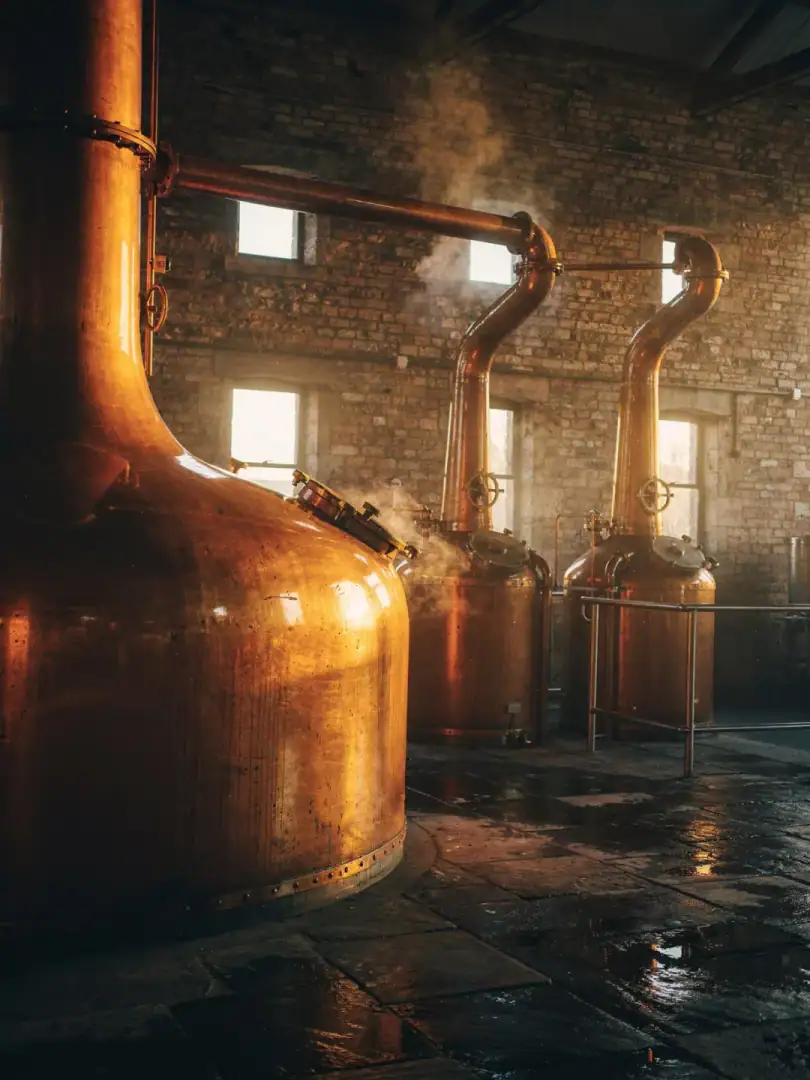
Springbank has only three stills, yet between them they do the work of six, running in shifting combinations. The wash still is still fired directly over an open flame to this day, a rarity in Scotland; most distilleries switched to steam coils long ago. The two spirit stills, however, run on steam.
This setup gives rise to Springbank's famous two-and-a-half-times distillation. Part of the low wines is drawn off before the second run and only redistilled later together with the feints. So part of the spirit passes through the still twice, another part three times, hence the figure two-and-a-half. The effect is a spirit that shifts between light and oily, trickier to pin down than a straightforward distillate.
For Hazelburn, the same equipment runs differently: here the spirit is triple-distilled, a method more typical of Ireland. The new-make spirit comes off the final still at 74 to 76 percent alcohol, unusually high for Scotland. Longrow, by contrast, is only double-distilled, entirely classic. That leaves its bold smoke with more weight.
Glen Scotia takes the simpler route: one wash still and one spirit still, double-distilled, as most Scottish malt distilleries do. Many credit this very simplicity for the house's comparatively light, grassy character.
Kilkerran, the whisky from Glengyle, is likewise made in a classic two-still setup. When Hedley Wright brought the distillery back into production in 2004, the stills arrived secondhand from the mothballed Ben Wyvis Distillery in Invergordon. That was a piece of whisky history that has been distilling Kilkerran ever since. So anyone drinking Kilkerran today is, technically, drinking spirit made in stills originally built for an entirely different whisky.