Peat by Choice
Malt & Peat
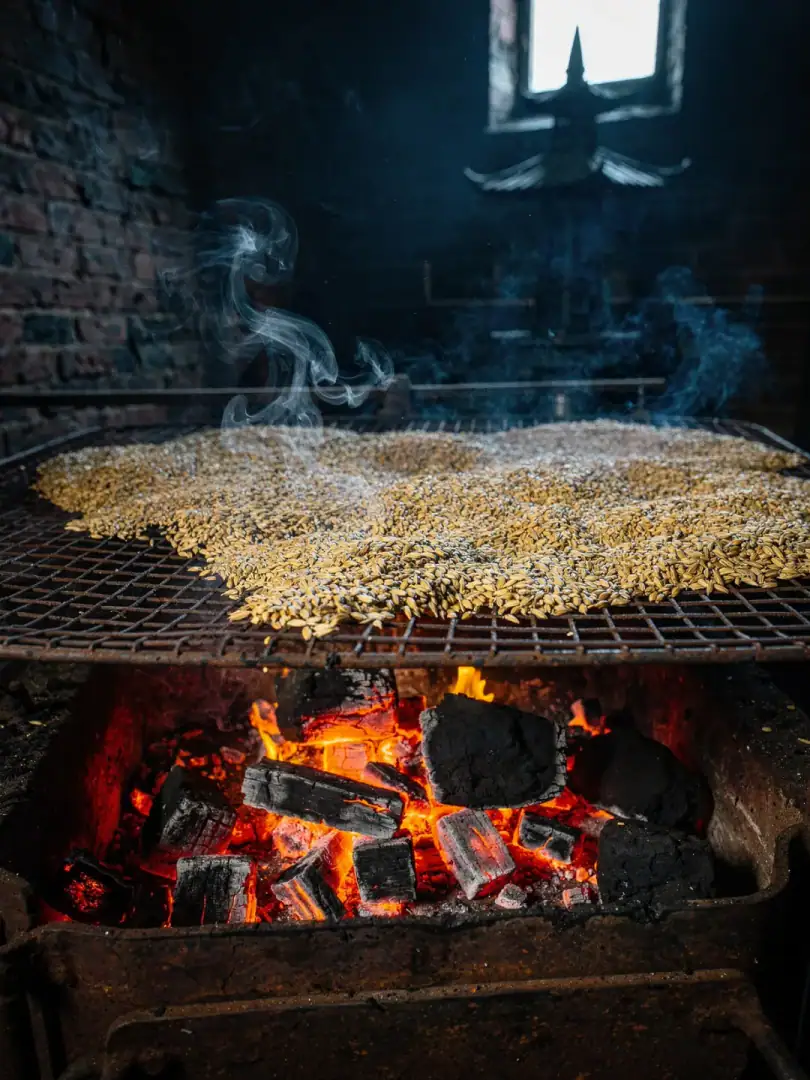
In Campbeltown, a single distillery takes on the role that entire factories usually play elsewhere. Springbank still malts part of its own barley today, on an open floor right in the heart of the operation. That's also where the peat comes into play. How heavily it burns determines three completely different whiskies, all made from the very same barley. Only a handful of distilleries in Scotland still work this way today.
After germination, the green malt moves to the kiln for drying. For Hazelburn, only hot air passes through the kiln, with no smoke at all. For the core Springbank whisky, peat smoke is added, but only briefly. The malt reaches roughly 12 to 15 ppm phenol content, a moderate level.
Longrow, on the other hand, gets the full treatment: the malt hangs in peat smoke for a long time and reaches 50 to 55 ppm. That figure calls Islay to mind far more than the gentle image many associate with Campbeltown. Three fuels, one building, three characters.
Glen Scotia and Kilkerran, by contrast, buy their malt ready-made from mainland maltings and don't specify their own peating level. As a result, their whiskies tend to come out gentler than Longrow, leaving more room for cereal, fruit and the salty side of the place.
Walking through Campbeltown, you see how much handwork still lies behind the word 'malt'. Elsewhere in Scotland it arrives ready-made by truck. Here, part of it is still turned and kilned on-site, with whatever smoke each style demands. It costs time and manpower, but it keeps alive a craft that has almost vanished elsewhere.
A thin layer of humus with grass roots, where the barley for Campbeltown's distilleries grows.
The root: This is where it's decided how much water and nutrients even reach the barley's roots.