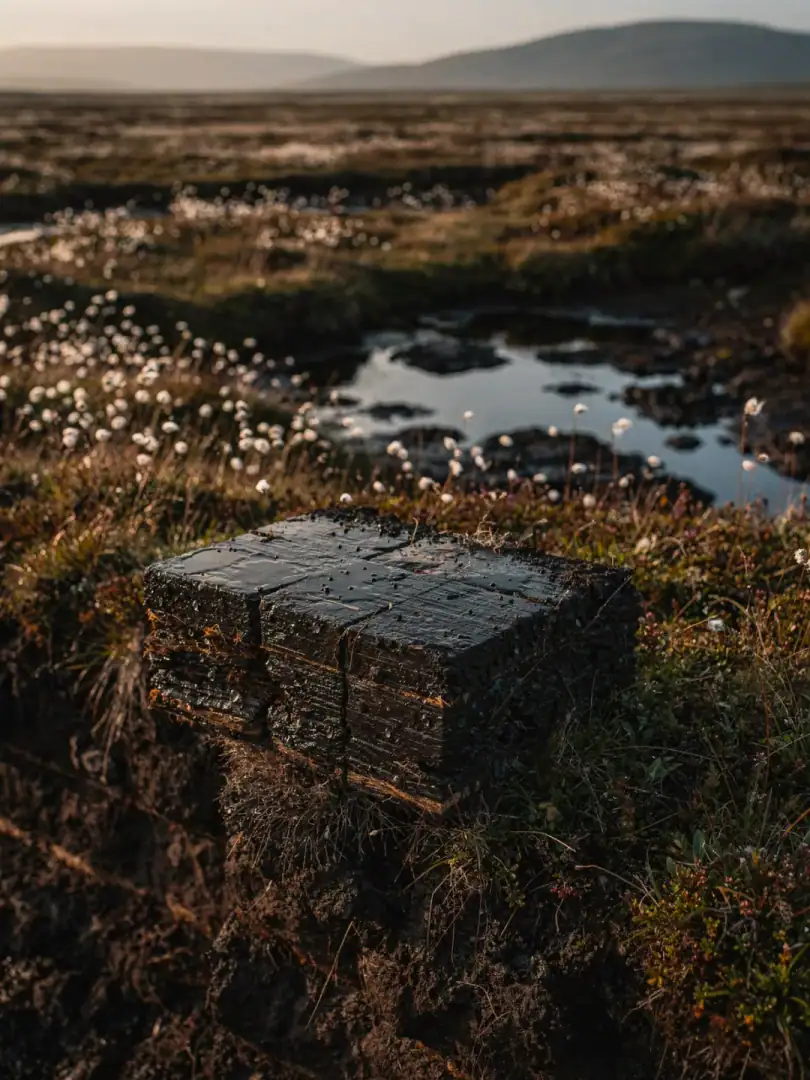
Peat in the north
Malt & Peat
Hardly any Highland distillery still malts its barley with peat today. In the south and centre of the region, around Glenmorangie or Aberfeldy, almost exclusively unpeated malt is used, dried with hot air rather than smoke. Things look very different in the far north, in the Flow Country between Caithness and Sutherland. It's the largest continuous blanket bog in Britain and, since 2024, a UNESCO World Heritage Site.
There, peat has been growing since the last Ice Age from decayed sphagnum moss, layer upon layer, century upon century. It was exactly this peat that once fuelled the kilns in which Highland maltsters dried their barley over smoke, before coal and oil replaced the manual work. Old distilleries like Wolfburn near the Flow Country still echo this closeness to the bog, in both name and water source.
Old Pulteney in Wick distills its standard releases entirely unpeated, typical of the northern Highlands. The distillery does, however, bring smoke back deliberately through peated casks, as in its 'Huddart' release. Further south, in Aberdeenshire, Ardmore is one of the few Highland distilleries that sources peated malt from the outset, a legacy from a time when smoke was part of almost every whisky.
Anyone walking through a Highland warehouse today will therefore rarely smell smoke, more likely wood, sherry and damp air. Peat remained a regional speciality here, not a rule as it is on Islay. This very inconsistency is what makes the Highlands so hard to sum up in a single sentence as a whisky region. From completely smoke-free to delicately peated, almost everything can be found here.
A cushion of moss that holds rainwater like a sponge and slowly compresses into peat.
The root: Without this moss, there would be no peat in the Flow Country to smoke malt with.