Every island does it differently
Distilling
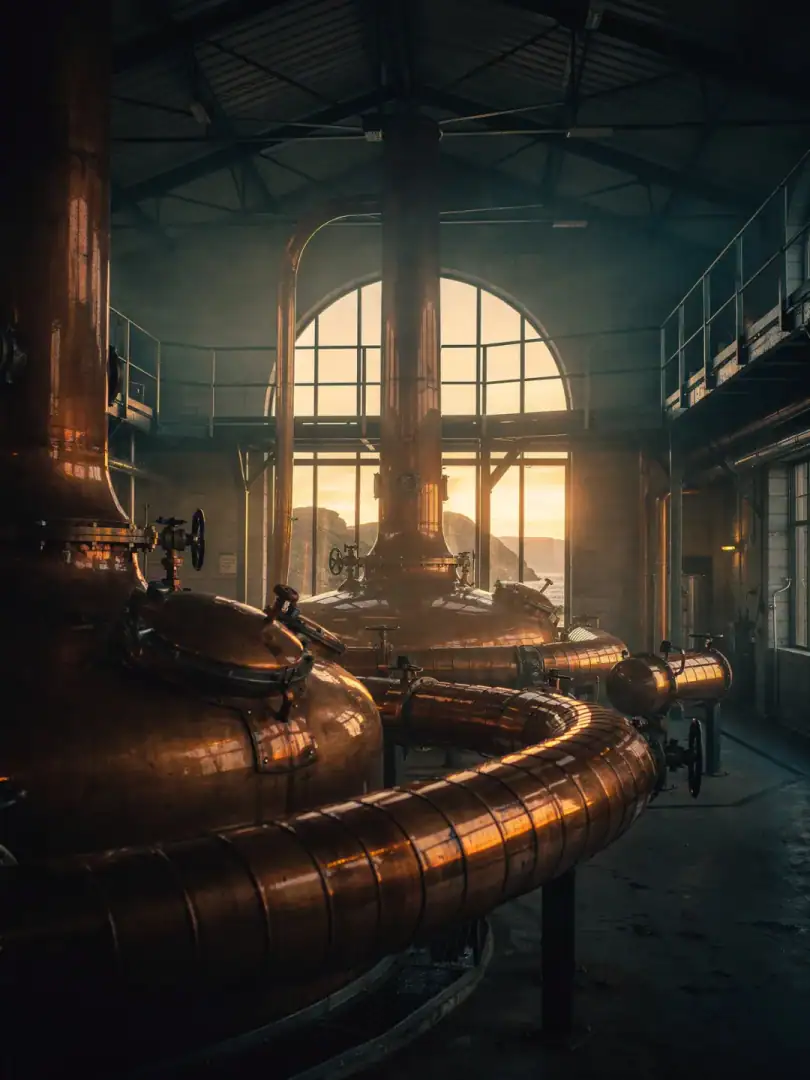
Hardly any still on the islands resembles another. Talisker on Skye distills with two large wash stills of 14,700 liters each, plus three smaller spirit stills of 11,000 liters each. This combination of two and three stills is one of the rarest setups in all of Scotland.
At the top of each Talisker still sits a U-shaped lyne arm. An additional return pipe channels part of the vapor back into the still, where it condenses early and is redistilled a second time. Cooling then happens not in modern shell-and-tube condensers but in traditional worm tubs, spiral copper coils sitting in cold-water tanks that give the spirit less copper contact and thus more weight.
Jura is home to the tallest stills in the region. The distillery was rebuilt in 1963 after decades of standstill. Engineer William Delmé-Evans deliberately designed tall, slender stills. Two wash stills hold 24,500 liters, two spirit stills hold 15,500 liters. Only the heavy, oily vapors manage to climb the long neck to the top; the rest falls back down. The result is a comparatively light, clean spirit that only gains depth once it hits the cask.
The islands' younger distilleries, by contrast, work deliberately small. Torabhaig on Skye and Lagg on Arran each run just one wash still and one spirit still. Everywhere, the same basic rule applies: double distillation in classic copper pot stills. There's no column still here, the kind used for American bourbon. It's the shape of the still, not the number, that ultimately shapes the character. This modesty might seem understated in the visitor centers, but it hardly makes a difference in the glass.