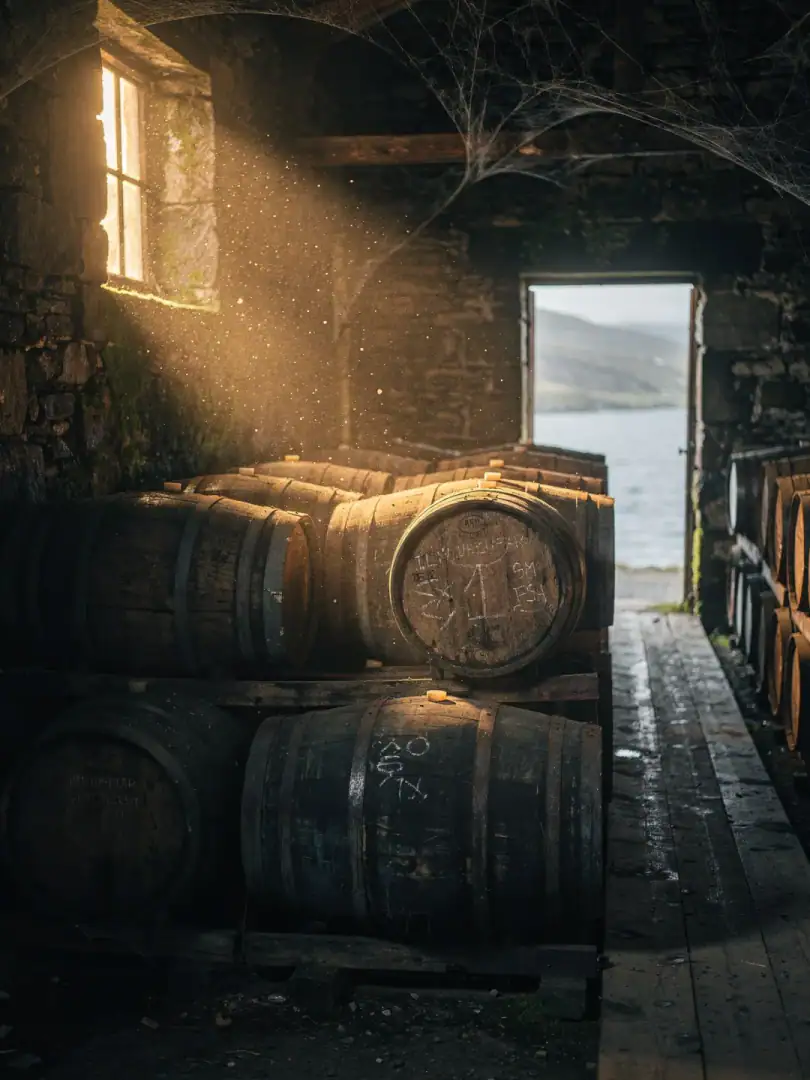
Sea air in the warehouse
Cask & Maturation
Highland Park skips ex-bourbon casks entirely, an exception among the major island distilleries. Maturation happens exclusively in oak casks that previously held sherry. European and American oak are blended together, giving the whisky its typical sweetness of raisins and orange peel.
Talisker takes the opposite approach, relying mainly on used bourbon casks made from American white oak, with a smaller share of sherry casks adding extra richness. The same ingredient, oak, produces a completely different character depending on what filled it before, even before the island wind gets involved.
Many of the region's warehouses sit almost at the water's edge, looking out over the open Atlantic. They have stone walls, earthen floors, and only a few cask levels stacked on top of each other, the classic dunnage style. The steady, damp island climate has hardly any major temperature swings, so the whisky matures more slowly here than in the warmer south of Scotland. The angel's share, the annual loss to evaporation, ends up comparatively modest next to hotter climates elsewhere.
On Arran and Jura, the distilleries happily mix both cask types together. Bourbon casks bring fruit and lightness, sherry casks add depth and color, often in one and the same bottling. This openness sets the islands apart from the stricter traditions found elsewhere in Scotland, where a distillery usually commits to a single cask style.
The legal minimum maturation of three years applies here just as everywhere in Scotland. In practice, though, most island whiskies stay in cask much longer. Ten years and beyond is more the rule than the exception on the region's labels, with the salty storage conditions doing the rest.