Rain, wind, maturation
Water & Climate
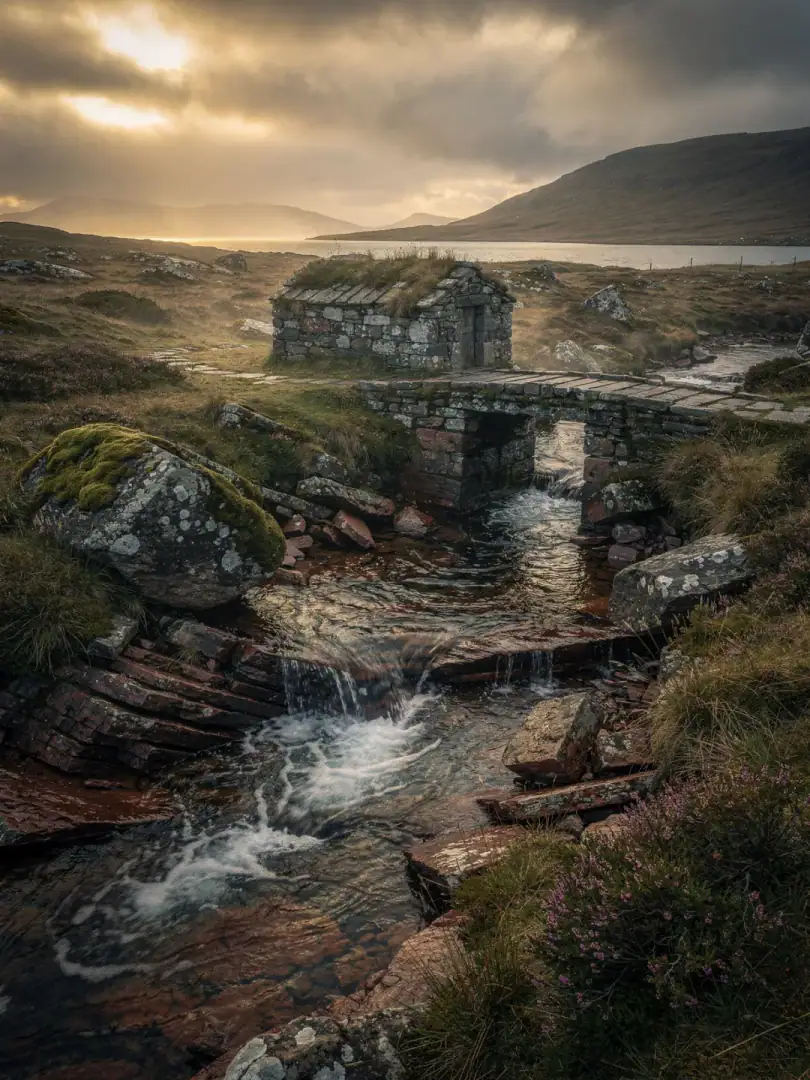
Every distillery on the islands swears by its own source, often the very same one for generations. Highland Park draws from Cattie Maggie's Spring on Orkney. Just half a kilometer away, Scapa takes its water from the Lingro Burn. On Jura, Loch a'Bhaile Mhargaidh feeds the distillery, named after the old marketplace on its shore. Each of these sources leaves its mark on the character of the resulting whisky.
Beneath each source lies different bedrock, and you can taste it. Orkney rests on red Old Red Sandstone, Skye on volcanic gabbro and basalt from the Cuillin mountains. Jura sits on hard quartzite, which forms the distinctive conical Paps of Jura. Arran, thanks to its geological diversity, is even called "Scotland in miniature": granite, sandstone, and slate all packed tightly together.
The Gulf Stream keeps the islands milder than their northerly location suggests, though mild doesn't mean calm. Atlantic storms sweep the coastlines almost year-round. The air stays damp and salty, with barely any major temperature swings. For cask maturation, that's a stroke of luck. Without big shifts between summer and winter, the whisky works more evenly in the warehouse. It matures more slowly than in the more continental climate of inland Scotland.
On Skye, Talisker sits right on Loch Harport. In a storm, sea spray practically reaches the warehouse walls. Whether salty air actually seeps through the porous stonework into the cask is still debated among distillers today. Hardly anyone doubts, though, that the maritime character of many island whiskies is tied to exactly this closeness to the sea.