Copper & shape
Distilling
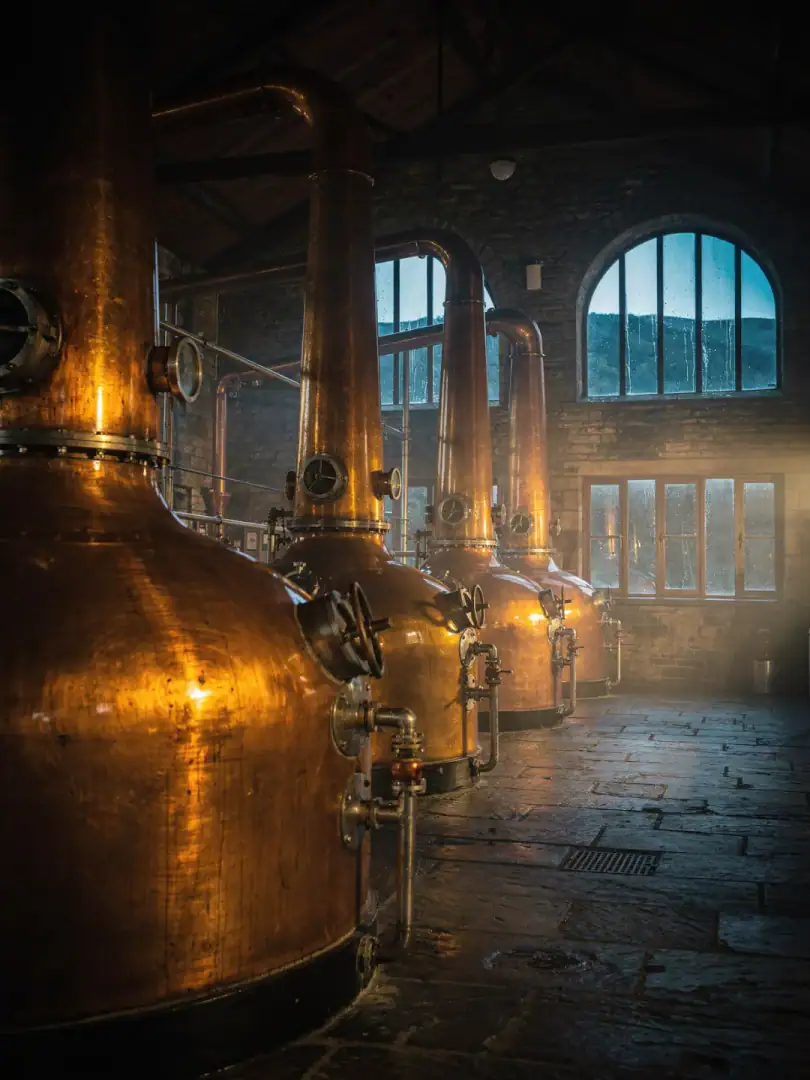
Every still house in Speyside has its own shape, and that is exactly where the region's diversity lies. At Glenfiddich and The Glenlivet stand tall, slender stills with long necks. Inside, the heavier vapour components repeatedly cling to the copper wall before the light, fruity remainder escapes at the top.
At The Macallan it's the opposite: there stand some of the smallest stills in the whole region, squat and short. Less copper contact means more heavy compounds in the finished spirit. The result is a dense, oily character that later pairs well with sherry casks.
Mortlach in Dufftown distils in the most idiosyncratic way of all. Six stills in six different shapes work together there. Part of the low wines runs through the smallest still, known in the house simply as the Witch, three times over. What results is a blend that connoisseurs call distilled 2.81 times, neither a double nor a triple in the usual sense.
Mortlach also cools its spirit in old worm tubs, long coiled copper pipes in troughs of water, rather than in modern shell-and-tube condensers. The vapour stays in contact with less copper for longer. As a result, the spirit stays heavier and more sulphury, almost meaty in flavour. Cragganmore and Dailuaine also work by this old principle.
Most other distilleries in the region, by contrast, rely on modern shell-and-tube condensers. As is customary in Scotland, they distil exactly twice: once for the coarse low wines, once for the fine middle cut, which the distiller separates by hand from the foreshots and feints. This double distillation remains, despite all differences in shape and size, the common thread of Speyside.