Menu, Order, and a Highball Finish
How Do You Plan a Whisky Dinner?
A whole evening with multiple whiskies alongside multiple courses requires more planning than a single pairing. Order, quantity, and a diluted finale like the Highball determine whether the evening still tastes good at the end, or simply sits heavily in the stomach.
The Order Makes the Evening
As with a wine menu, the basic rule also applies to a whisky dinner: light before heavy, dry before sweet. An evening that begins with a bold, heavily peated Islay whisky ruins the palate for anything more delicate that follows, since the smoke lingers for a long time and simply drowns out quieter aromas.
It makes sense, therefore, to begin such an evening with a light, pale blended whisky or a young single malt for the starter, followed by bolder sherry-cask or peated styles for the main course. The finale is usually a sweet, old whisky for dessert, fitting with the previous stop on this journey.
A quick glance at the guest list helps further. Less experienced guests tolerate fewer extremes than seasoned connoisseurs. For them, a gentler start to the evening is worthwhile. Experienced guests, on the other hand, can be given something bolder earlier on without issue. This way, the whole evening remains enjoyable for everyone. A good host usually senses this difference intuitively.
How Many Whiskies, How Many Courses
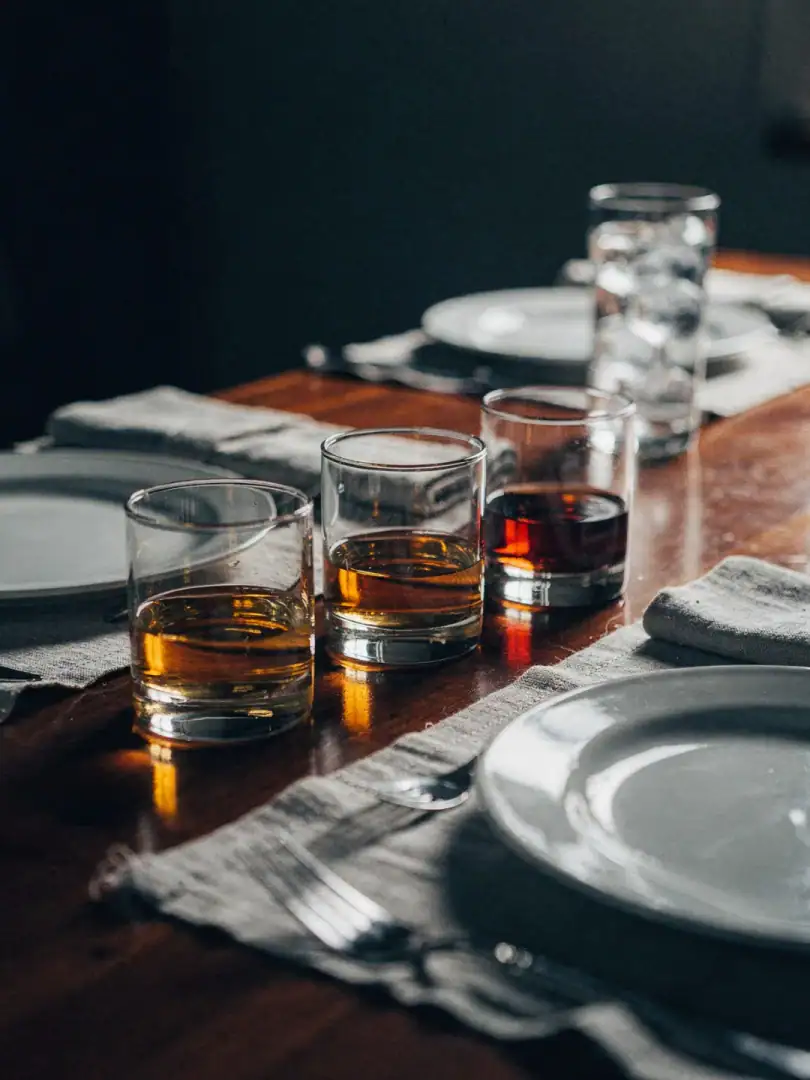
For a dinner at home, three to four different whiskies for as many courses is usually completely sufficient; any more quickly overwhelms even seasoned guests. Each whisky should be poured only in a small amount, around two centiliters, so there's still enough concentration left for the final course by the end of the evening.
Between individual courses, still water and a neutral piece of bread help reset the palate, much like the pickled ginger did with sushi at an earlier stop. Anyone wanting to mix things up internationally will now also find distinctive bottlings from German distilleries, well suited to one of the first, lighter courses.
The order of the courses themselves matters too. A light fish course before the meat almost always works well. A heavy course right at the start, by contrast, tires the palate quickly. Anyone who keeps this simple order in mind plans the evening more relaxedly without even trying.
The Highball as a Light Finale
A Highball consists of whisky, plenty of ice, and cold soda water in a tall glass, usually in a ratio of about one part whisky to three parts soda. This heavy dilution significantly lowers the alcohol content, keeps the soda water's carbonation noticeably intact, and makes the whisky light, fizzy, and refreshing.
At the end of a multi-course dinner, a Highball works especially well as the final drink of the evening, since it won't sit heavy on the stomach and lets the night wind down gently rather than closing it out with another strong, neat pour. In Japan, it's traditionally served with many meals, extending well beyond its role as a closing drink.
A Highball can also be served in the middle of a menu. Between two rich courses, it acts like a brief pause. The palate noticeably recovers, getting ready for the next course. This break is especially worthwhile during long dinner evenings.
Glasses, quantities, and one final rule of thumb
For a relaxed evening, a single neutral glass per person is perfectly sufficient, as long as it's briefly rinsed with a bit of water between whiskies. Those who prefer more precision can set out a fresh glass for each whisky, which makes it much easier to compare the individual bottlings directly.
In the end, what matters most at a whisky dinner isn't following a perfect rule but building your own experience: noting down which pairings worked especially well lets you develop a reliable repertoire over time, taking the guesswork out of your next evening.
A timeline for the evening also helps enormously. There should be enough time between courses for conversation. Rushed drinking robs every pairing of its true effect. Taking your time simply means tasting more in the end.