Something Sweet with Whisky
Which Whisky Pairs with Dessert and Chocolate?
Some consider sweets and whisky a tricky pairing, yet whisky itself is full of natural sweetness: caramel, vanilla, dried fruit. Anyone who finds this sweetness in the glass and matches it with the dessert on the plate discovers one of the most rewarding pairings of this whole journey.
Where the Sweetness in Whisky Actually Comes From
Whisky contains no added sugar; its sweetness comes solely from the cask wood and the grain processing. When the inside of the cask is charred, vanillin precursors and caramelized sugar compounds form, migrating into the whisky over years and giving it a natural, often barely conscious sweetness, even though by law no sugar may be added.
The longer the maturation and the more active the cask, the more of this sweetness accumulates in the finished whisky. An old whisky matured in sherry or port casks therefore often already carries aromas strongly reminiscent of raisin cake, toffee, or dark chocolate, even before any dessert has reached the table.
A simple comparison makes this clear. A young whisky from a tired cask tastes barely sweet at all. The same whisky from a fresh, active cask, by contrast, tastes noticeably sweeter. Both may come from the very same distillery. The cask alone decides this difference.
Dark Chocolate: The Most Reliable Partner
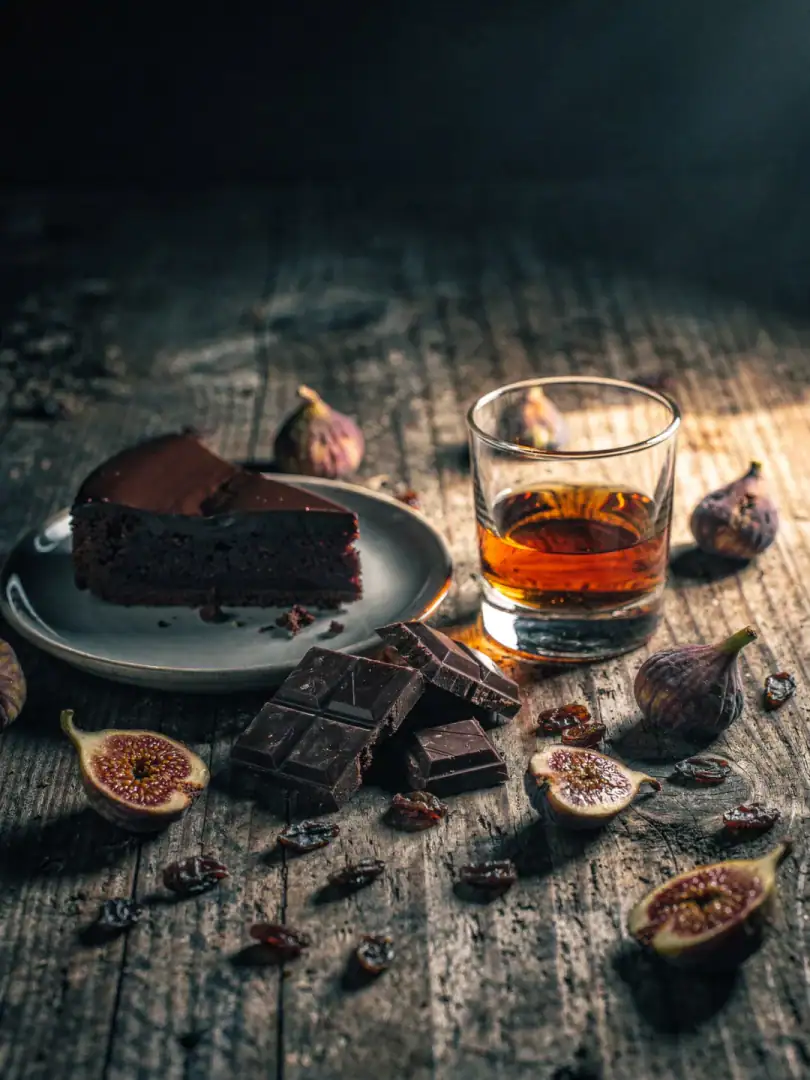
Dark chocolate with a high cocoa content and little inherent sweetness almost always pairs well with a sweeter, bolder whisky from a sherry or port cask. The chocolate's slight bitterness catches the sweetness of the whisky, while the whisky, in turn, rounds off the chocolate's bitterness, so both sides come across softer.
Milk chocolate, with its considerably higher inherent sweetness, calls instead for a drier, less sweet whisky, otherwise the pairing quickly tips into excess. Two sweet extremes side by side rarely feel harmonious, no matter how high-quality each is on its own.
A small test helps with your own choice. Let a piece of chocolate slowly melt in the mouth, then try the whisky. This quickly reveals whether the two sides work together. If the combination feels too sweet, a drier whisky helps on the next attempt.
Pastries, Caramel, and the Question of Cask Maturation
Caramelized desserts like crème brûlée or a warm apple cake with caramel sauce almost automatically meet whisky from fresh or lightly used bourbon casks, since both bring the same caramel note to the fore. This pairing feels rounded and coherent, without either side needing to outdo the other.
Fruity desserts with dried fruit, such as a fruit bread or a Christmas pudding, pair especially well instead with sherry-cask whisky, whose own raisin and fig notes directly echo the fruit notes of the dessert. Here too, the same principle from the game and roast station applies: same aroma family, same effect.
Warm dishes also change the impression in the glass. Warmth releases additional aromas in the dessert. A cold dessert, by contrast, often comes across more restrained in flavor. Given the choice, it's best to serve caramel desserts still slightly warm. A scoop of vanilla ice cream alongside further softens any sharpness in the whisky.
Whisky Instead of Dessert: When the Glass Replaces the Sweet Course
A particularly old, very sweet whisky can, on certain evenings, serve entirely on its own as dessert, without any plate needed at all. Long-matured sherry-cask bottlings in particular bring enough richness, sweetness, and length in the finish to stand on their own.
Anyone choosing this route should opt for a smaller glass and a quiet setting, so the subtle nuances don't get lost in background noise. A single, well-chosen whisky can often replace an entire dessert buffet on such evenings.
A small piece of dark chocolate still pairs well alongside it. It rounds off the finish without overpowering the whisky. More important than any accompaniment, though, remains taking your time while drinking. A rushed sip almost always loses depth.