Youngest cask counts
Age statement & NAS
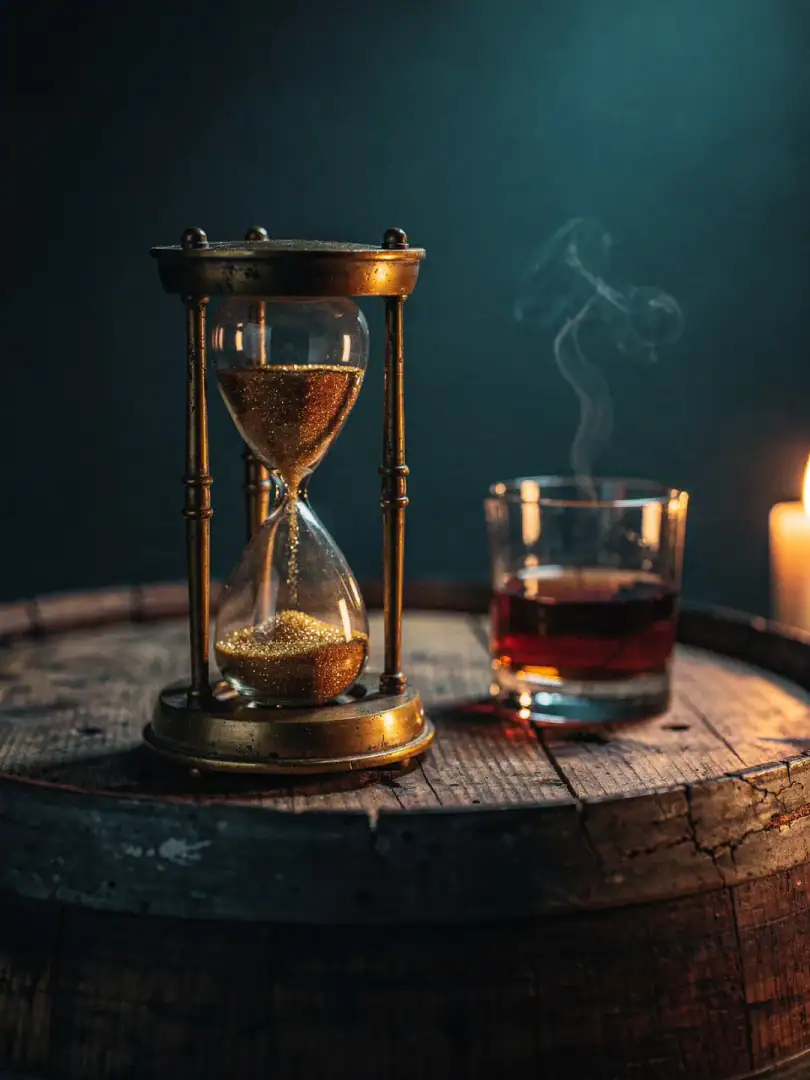
If a number appears on the label, say 12 Years, a strict rule applies: it doesn't describe an average, but the youngest cask in the bottle. More and more whiskies now skip this number entirely and call themselves No Age Statement.
Why the number refers to the youngest cask
Most whiskies, especially blends, are made from casks of different ages. A producer blends ten-, twelve-, and fifteen-year-old whisky to achieve a consistent flavor. The SWR and comparable rules in other countries specify that an age statement on the label always refers to the youngest component included, never the average and never the oldest cask. So twelve years on the label means at least twelve years for every single drop in the bottle.
This rule protects against exaggeration. Without it, a producer could add a single drop of forty-year-old whisky to a bottle of young whisky and still advertise a high age. The youngest-cask rule prevents exactly that and turns the number on the label into a reliable, verifiable promise that every distillery must be able to prove on request.
What No Age Statement means
Since roughly the 2010s, more and more bottles carry no number at all, labeled as No Age Statement, or NAS for short. The reason lies in demand: the global whisky boom shrank stocks of truly old casks while sales kept rising at the same time. A producer promising twelve-year-old whisky but lacking enough of it in storage runs into a bind. NAS solves the problem by allowing younger and older whisky to be freely blended, without committing to a fixed minimum age.
For you as a buyer, NAS doesn't automatically mean lower quality. Some NAS bottlings even contain above-average-aged whisky, the producer simply doesn't state the number in order to stay flexible with future supply. Other NAS bottles genuinely consist mostly of young whisky. There's no way to tell the difference from the outside without a number on the label, only the distillery's reputation and the price offer rough guidance.
Why a high age doesn't automatically mean better taste
Maturation isn't a linear process where more time always means more quality. Whisky absorbs color, flavors like vanilla or caramel, and a softer texture from the wood, but at the same time loses alcohol to evaporation, the so-called angels' share. After too many years, a whisky can be overwhelmed by the wood and taste bitter, dry, or overly tannic. A good blender therefore chooses the maturation time to suit the cask and climate, not to chase the highest possible number.
The pace of maturation also depends heavily on climate. In Kentucky's warm summers, Bourbon matures noticeably faster than Scotch in a cool Scottish warehouse, because heat speeds up the exchange between wood and alcohol. A ten-year-old Bourbon can therefore taste more intense than a Scotch of the same age. So the number on the label only tells you about the minimum time, nothing about the actual rate of maturation.
How to read an age statement in context
Never compare an age statement in isolation, always alongside the category and the price. A twelve-year-old Single Malt from a small, well-known distillery can taste completely different from a twelve-year-old blend made from cheap grain and malt whisky, even though both carry the same number. The year figure only describes the minimum maturation, not the composition or the cask quality behind it.
Some distilleries deliberately combine both approaches. They sell a core range with fixed age statements for consistency, alongside NAS special releases for more creative cask selection. Anyone who understands the number, but also knows when it's missing and why, ultimately reads a label far more carefully than someone who just looks for a high year figure.