US categories
Bourbon, Straight, Bottled-in-Bond
In the USA, Title 27 CFR Part 5 from the federal agency TTB governs what Bourbon, Straight Whiskey, and Bottled-in-Bond are allowed to mean. Each tier tightens the rules further, from a minimum amount of corn to an exact number on the bottle.
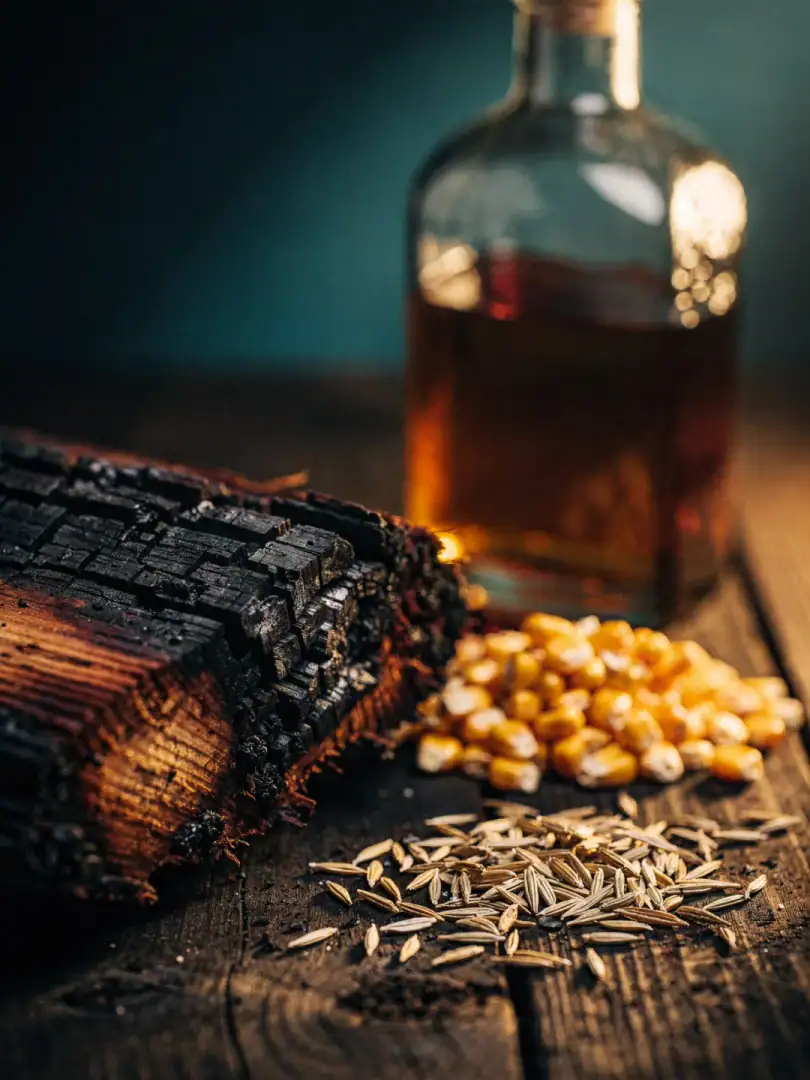
What makes Bourbon Bourbon
Bourbon must be produced in the USA, that's the only geographic requirement, so Kentucky isn't a legal obligation, just a tradition. The mash must consist of at least 51 percent corn, with the rest usually made up of rye or wheat along with malted barley. It may be distilled to no more than 160 US proof, that's 80% ABV, and barreled at no more than 125 proof, or 62.5% ABV.
The most important rule concerns the cask: Bourbon matures exclusively in new, charred oak barrels, which may never be used for Bourbon again afterward. It's exactly these used barrels that US distilleries then sell on to Scotland, Ireland, or Japan, where they get a second life for Scotch, Irish Whiskey, or Japanese Whisky. Bourbon is bottled at a minimum of 80 proof, that's 40% ABV. The law doesn't require a minimum maturation period for plain Bourbon.
Straight Bourbon: the stricter tier
The addition of Straight tightens the rules further. Straight Bourbon must mature for at least two years in new, charred oak barrels, and nothing may be added during that time, no color, no flavoring, no neutral drinking alcohol. All the color and all the flavor must come from grain and cask. That's exactly why added caramel coloring is banned in Straight Bourbon, while it's explicitly permitted in Scotch, a difference that will matter again at the coloring stop.
If a Straight Whiskey is younger than four years, the bottle must carry an age statement; from four years onward, this becomes optional. If a bottle contains multiple vintages, the rule of the youngest component applies here too, just as in Scotland. Straight Rye follows the same rules as Straight Bourbon, only with at least 51 percent rye instead of corn in the mash.
Bottled-in-Bond: the government-verified tier
Bottled-in-Bond is the strictest and also the oldest of these categories, governed by a law from 1897. The whiskey must come from a single distillery, from a single master distiller, produced within a single season, either January through June or July through December. It must mature for at least four years in a government-supervised, sealed warehouse, a so-called bonded warehouse, under the oversight of US customs authorities.
It's bottled at exactly 100 US proof, that's exactly 50% ABV, no higher and no lower figure is allowed. Only water may be added, in order to hit this value precisely. The law was originally created to protect buyers from diluted and counterfeit whiskey, at a time when there was still no general food regulation. Today, Bottled-in-Bond is mainly a quality signal for connoisseurs, no longer a legal requirement.
Why this tiered system helps when buying
The three tiers, Bourbon, Straight Bourbon, and Bottled-in-Bond, together form a kind of ladder of trust. Plain Bourbon guarantees the basic ingredients and the new oak barrel but reveals little about maturation time or purity. Straight Bourbon adds a minimum maturation period and a ban on any additive besides water. Bottled-in-Bond goes the furthest, tying distillery, season, maturation time, and alcohol strength to fixed, government-verified values.
For your shopping, this means: if Bottled-in-Bond is on the label, you can rely on a government-controlled definition that hasn't changed in over a hundred years. If there's no qualifier and the bottle just says Bourbon, it's worth a second look at the age statement and alcohol content to get a better sense of the actual quality.