Evaporation in the Cask
What Is the Angel's Share in Whisky?
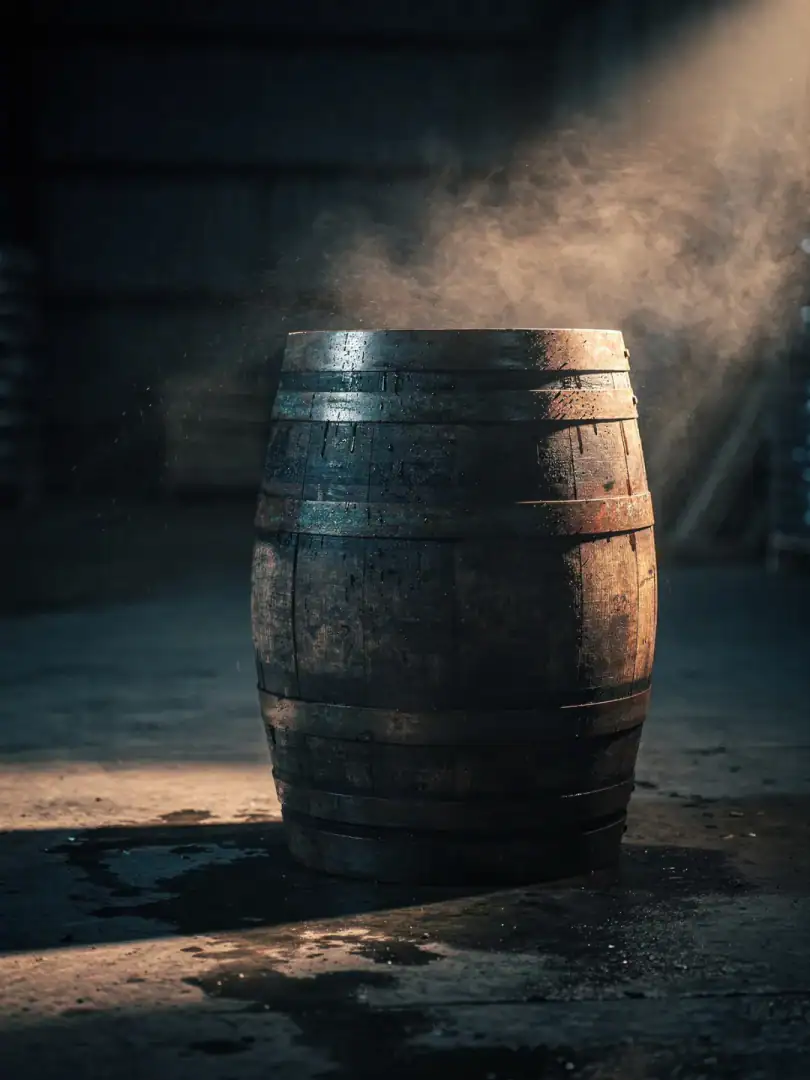
Every year, part of the whisky evaporates through the cask wood, known as the angel's share. How much disappears, and whether it's mostly water or alcohol, depends above all on the climate at the storage location.
What the Angel's Share Is
Because wood is never fully airtight, part of the cask's contents evaporates through the staves into the outside air every year. This loss is called the angel's share, since no one can capture it, it simply vanishes into the air of the warehouse.
In Scotland, this loss is usually around two percent per year, measured by liquid volume in the cask. Over twelve or eighteen years of maturation, this adds up noticeably, and often only a portion of the originally filled volume remains in the end.
Why Climate Makes the Difference
The warmer and drier the climate, the more evaporates. From warm regions such as India or Taiwan, distilleries report annual losses well above ten percent, sometimes more than five times the Scottish figure.
The reason lies in the interplay of warmth and humidity: warm air holds more moisture, which speeds up both evaporation and the chemical interaction between whisky and wood. As a result, whiskies in such climate zones can mature as intensely in just a few years as some Scotch whiskies only achieve after a decade.
What Exactly Evaporates: Water or Alcohol?
Whether water or alcohol escapes more depends on the humidity at the storage site. In humid climates, such as along the Scottish coast, relatively more alcohol evaporates than water, so the whisky gradually becomes milder in strength over the years.
In drier climates, such as parts of Kentucky, more water evaporates instead, which can actually increase the alcohol content. That's why some American bourbons grow stronger in the barrel over time, while many Scotch malts gently lose strength over the years, with no water ever added.
The Price of Evaporation
Economically, the Angel's Share represents a real loss: every year of maturation costs volume that can never be sold later. With very long maturation of twenty years or more, over a third of the original cask contents can disappear, one reason why very old whiskies are so much more expensive than young ones.
At the same time, this very loss is closely tied to the quality that many people prize in old whisky. Without the slow evaporation through the wood, there would be no concentration of flavors in the cask either, what the angels take, in the end gives the rest its depth back.
The Black Fungus on Warehouse Walls
The Angel's Share has another visible side effect outside the cask. A thin, black coating often grows on the walls and roofs around old warehouses. Behind it is a fungus called Baudoinia compniacensis, which feeds on the alcohol vapors released by evaporation. Wine regions like Cognac have known this phenomenon for longer than the whisky industry has.
The fungus is considered completely harmless to humans and to the whisky itself, it only grows on the outside of buildings. Still, it annoys some neighbors of distilleries, since it permanently blackens facades, fences, and even parked cars. In some regions, this has already led to disputes and even lawsuits against distilleries. Some operations now clean their buildings regularly to limit the problem.
For experts, the black coating also serves as an interesting, indirect clue to the proximity of a maturation warehouse. The denser the fungus grows, the more alcohol is presumably evaporating in the immediate vicinity. Some researchers even use this to roughly estimate the actual amount of evaporation. Without opening a single cask, the wall outside already reveals something about what's happening inside.
Unlike the casks themselves, this side effect can hardly be avoided entirely as long as any alcohol evaporates at all. Some new warehouses are now deliberately planned with distance from residential areas or sensitive facades in mind. Filtration systems that pull vapors from the air remain expensive so far and rare in the industry. The Angel's Share thus remains a compromise that the surroundings of a warehouse have to share in.
In the end, it becomes clear that evaporation changes the whisky itself while also shaping its entire surroundings. What is gained in flavor inside the cask leaves visible traces outside on walls and roofs. For visitors to many distilleries, the black coating is often the first visible sign of decades of maturation, even before they've seen a single cask.