Where Casks Rest
What Is a Dunnage Warehouse, What Is a Rickhouse?
Whether a damp dunnage warehouse in Scotland, a modern high-rack facility, or a hot rickhouse in Kentucky: where a cask sits changes the pace and direction of maturation almost as much as wood type or cask size.
Dunnage: The Traditional Stone Warehouse
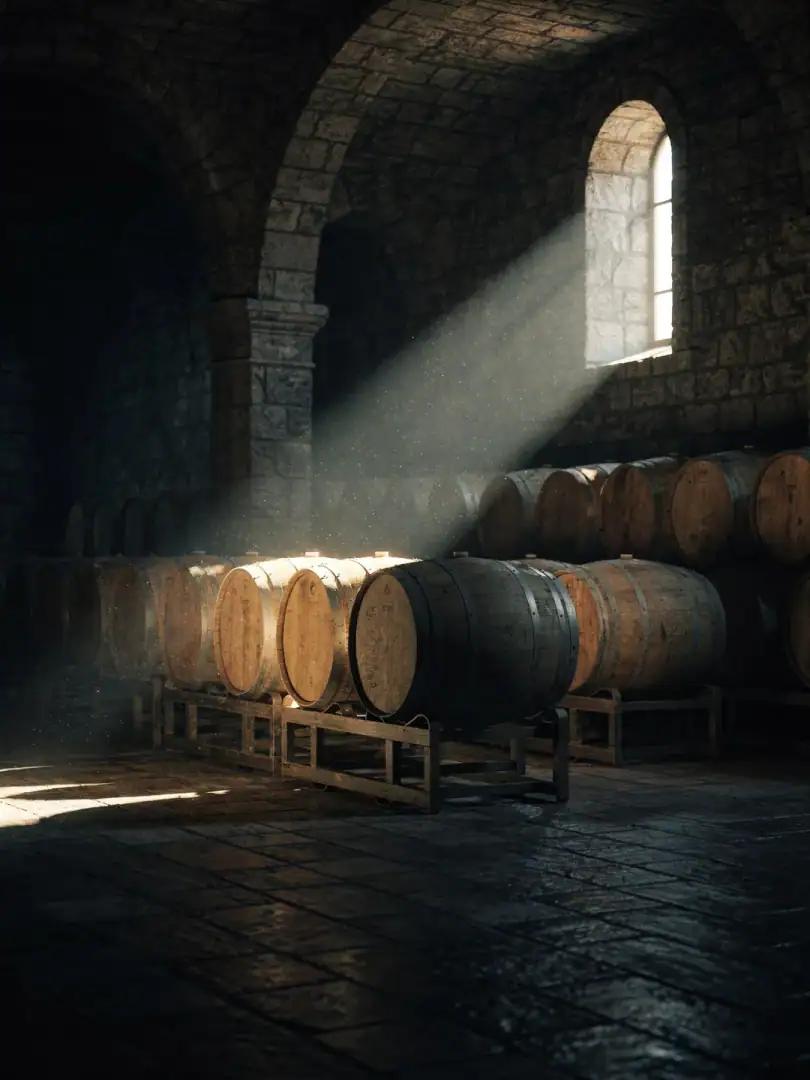
In Scotland, low stone buildings with clay or gravel floors, called dunnage warehouses, traditionally house casks stored on their sides, usually stacked only two to three tiers high, supported on wooden rails. The thick stone walls and damp earthen floor keep the temperature relatively stable year-round and humidity high.
These conditions are traditionally regarded in the industry as particularly gentle for slow, even maturation. The downside: dunnage warehouses require a lot of floor space for comparatively few casks, which is why today they're mostly reserved for select or older stocks.
Racked: The Modern High-Rack Facility
More modern are racked warehouses, tall steel buildings where casks are stacked on multiple levels in racking systems, often eight to twelve tiers high. This saves enormous amounts of space and can be managed more easily with forklifts than the narrow aisles of a dunnage warehouse.
However, such buildings experience greater temperature differences between levels: it gets noticeably warmer at the top in summer than at the bottom, which makes maturation proceed at different speeds depending on cask position. Some bottlers therefore rotate casks during storage to even out this difference.
Rickhouse: America's Answer to Heat and Cold
In the US, the typical warehouses are called rickhouses or rackhouses, usually multi-storey wooden or brick buildings with seven or more floors. Because Kentucky has hot summers and cold winters, the temperature varies enormously between floors, often ten to twenty degrees warmer at the top than at the bottom.
Bourbon distilleries use this deliberately: casks from the hot upper floors mature faster and more intensely, while casks from the cooler lower floors mature more slowly. Some brands deliberately blend casks from different floors to achieve a particular flavour profile.
Why Storage Location Matters
Whether a cask matures in a damp dunnage warehouse in Scotland, a climatically stable racked warehouse, or a hot rickhouse in Kentucky changes the pace and direction of maturation almost as much as wood type or cask size. Two identically filled casks can taste completely different after twelve years in different locations.
That's why storage location is a deliberate decision for distilleries, not a mere formality. Some even deliberately move casks between climate zones to speed up maturation, as the next stage on evaporation and climate will show in more detail.
Pallet Warehouses: The Third Modern Storage Type
Alongside dunnage and racked warehouses, many newer distilleries have adopted a third format, the pallet warehouse. Here, casks stand upright on wooden pallets, usually stacked in twos or fours. Forklifts move entire pallets at once, rather than lifting individual casks by hand. This significantly speeds up loading and unloading compared to older methods.
Because casks stand upright rather than on their sides here, the contact between whisky and wood also changes slightly. The bung typically faces upward in standing casks, meaning less surface area remains permanently wetted. Some distilleries therefore regularly rotate their pallet-stored casks to keep maturation more even. Others see no relevant difference from horizontal storage.
Pallet warehouses often require less space than dunnage halls, but more than a fully automated high-rack facility. For growing distilleries, this offers a practical middle ground between tradition and efficiency. New distillery start-ups without historic stone buildings therefore often opt for this more modern format. It's also easier to expand as production grows in the coming years.
Critics of the old school argue that pallet warehouses benefit less from the natural temperature fluctuations of a stone building. Supporters counter that modern climate control has long since compensated for this drawback. Which method is ultimately the "right" one remains a matter of debate in the industry to this day. Taste alone rarely allows one to identify the storage type beyond doubt anyway.
For most consumers, the storage type remains invisible regardless, since it rarely appears on the label. What matters more than the warehouse's construction is, in the end, how consistently temperature and humidity are controlled over the years. Whether dunnage, racked, or pallet storage: all three can produce excellent whisky given good management.