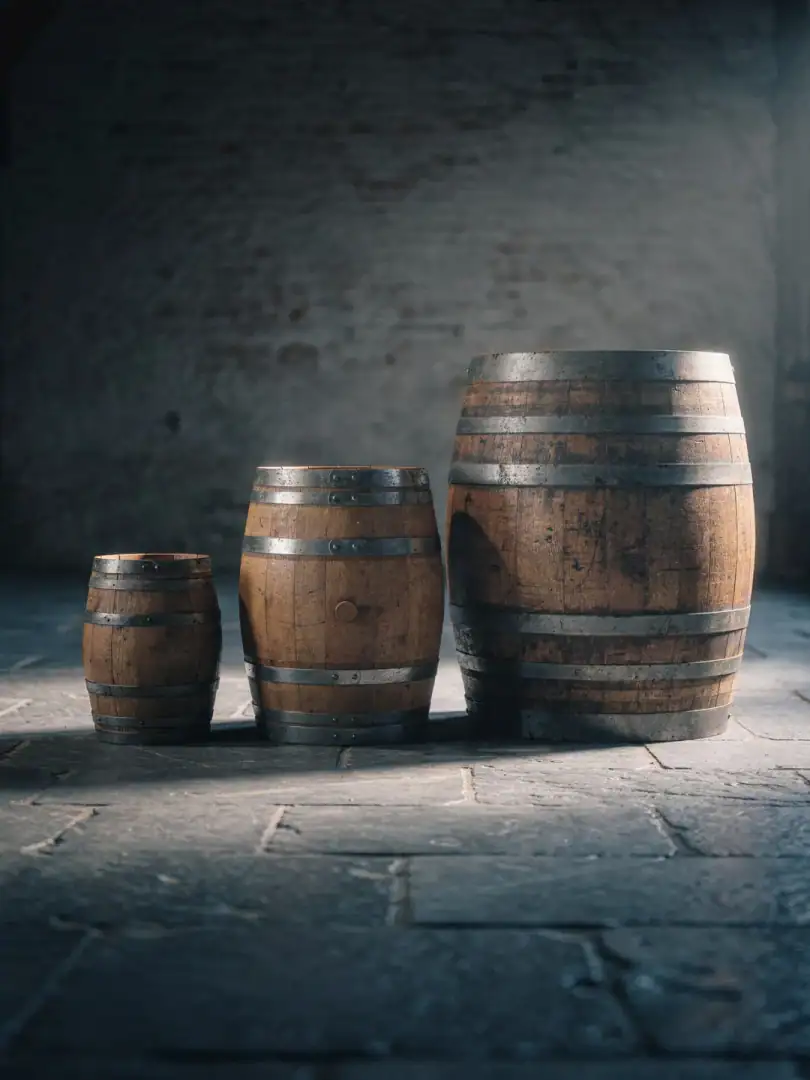
Smaller Matures Faster
What Cask Sizes Exist in Whisky?
From the small octave to the large butt: the smaller a cask, the more wood surface meets every litre of whisky, and the faster and more intensely the maturation proceeds.
From Barrel to Butt: The Sizes
The American bourbon barrel, also called an ASB, holds around two hundred litres. The hogshead, often built from converted bourbon barrels with additional staves, holds roughly two hundred and twenty-five to two hundred and fifty litres.
Considerably larger is the sherry butt at around five hundred litres, similarly sized to the puncheon at about four hundred and fifty to five hundred litres. Smaller specialty sizes such as the quarter cask at around one hundred and twenty-five litres or the octave at about fifty litres are usually only used for a short, intense finish.
Surface Area to Volume: The Real Rule
What matters is not the litre count alone, but the ratio of wood surface area to liquid volume. A small cask has, relative to its volume, much more contact area with the wood than a large one, meaning the whisky, proportionally speaking, touches significantly more wood.
That's why whisky matures faster and more intensely in an octave than in a butt, even if both casks come from the same oak and are stored for the same length of time. Small casks can make young whisky seem mature quickly, without many years actually having passed.
Why Smaller Isn't Always Better
Fast maturation sounds practical, but it comes at a price: in small casks, the wood can quickly overwhelm the actual character of the new-make spirit, so that in the end mostly cask aroma rather than distillery character ends up in the glass. Larger casks such as the butt or puncheon give the whisky more time to develop its own style.
That's why many traditional distilleries prefer larger casks for the main maturation and deliberately use smaller formats only for short finishing phases, where a quick, clearly noticeable flavour boost is desired.
Cask Size as a Control Lever
For distilleries, cask size is also a matter of space and economics. Small casks require more storage area per litre of whisky and more labour, since significantly more individual casks need to be moved. Large casks can be stored more efficiently, but mature more slowly and thereby tie up capital for longer.
In the end, cask size is a deliberate control lever that distilleries and bottlers use to steer the pace and intensity of maturation, just like the wood type and char level from earlier stages of this journey.
Why the Standard Size Prevailed Historically
The size of the classic cask is no accident, but the result of centuries of practice. A full cask of around two hundred litres weighs well over two hundred kilograms. That's just about heavy enough for two people to roll and tilt it without mechanical aids. Larger casks would have been almost unmanageable for horse-drawn carts and early warehouses.
Long before modern whisky, wine merchants and beer brewers already used similar cask sizes for transport and storage. As the whisky industry grew in the nineteenth century, it simply adopted these already established measurements. A uniform format also made trade easier between distilleries, ports, and bottlers. Different sizes would have made warehouses and transport routes unnecessarily complicated.
To this day, this historical practicality shapes modern warehouses, even though forklifts and cranes have long since taken over the heavy lifting. Racked warehouses, for instance, are designed precisely to the dimensions of the classic barrel and hogshead. An unusually large or small cask often doesn't fit the existing racks. That's why special formats like the octave or quarter cask remain the exception even today.
For coopers, the standard size also means simpler production. Tools, hoops, and staves can be manufactured in large quantities for the same shape. This significantly lowers costs compared to constantly changing special dimensions. Only for special finishing purposes is the extra effort of smaller, custom casks worthwhile.
So today's cask size combines several requirements at once: human manageability, centuries-old trading habits, and modern warehouse logistics. What once arose out of practical necessity has long since become a global industry standard. Even new distilleries in Asia or North America usually build their warehouses to this old measure. The story of a cask thus begins long before its first whisky filling. Knowing this, one sees a piece of practical engineering in every rack full of casks.