The Basics of Maturation
Why does whisky mature in wooden casks?
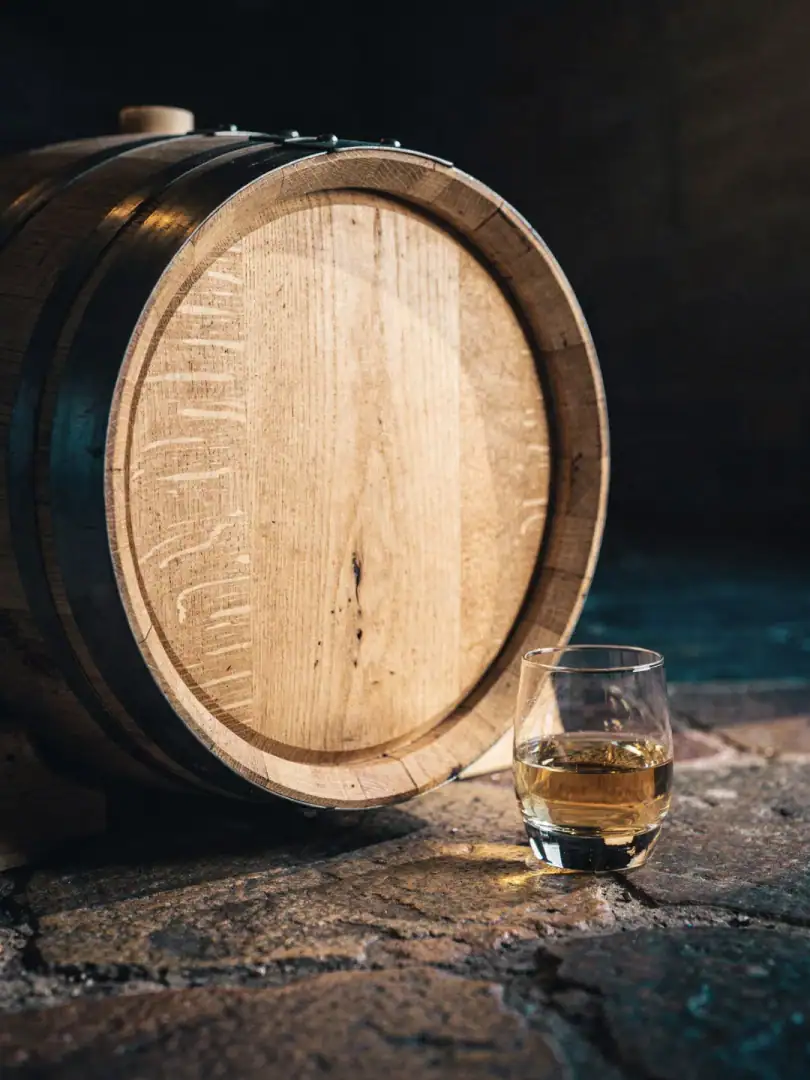
Whisky comes off the still clear and sharp. Only the oak cask gives it colour, flavour and calm, and laws around the world set the rules too: without at least three years in a wooden cask, a drink can't even be called whisky.
Why not steel, why not glass?
Straight from the still, the new make spirit is crystal clear and bitingly sharp, almost like a neutral vodka. In theory, distilleries could store it in steel tanks, which are cheaper and easier to clean than wood. But steel and glass seal the liquid off completely, nothing can get in or out.
Oak, on the other hand, stays tight enough not to lose a single drop, yet lets tiny amounts of air slowly pass through the staves over the years. Historically, this wasn't a deliberate trick: wooden casks were simply the standard transport and storage vessels of their time, and the maturation effect was discovered more by chance than by design.
What really happens inside the cask
Inside the cask, substances migrate from the wood into the whisky: vanillin precursors, tannins and sugar breakdown products from the lignin release colour, sweetness and spice that were absent from the new make spirit before.
At the same time, the charred inner layer absorbs unwanted, sulphurous compounds from the young spirit, similar to an activated charcoal filter. Oxygen also slowly seeps in through the wood's pores over the years, allowing new, fruity aroma compounds to form. These processes happen simultaneously and slowly, which is why a three-year-old whisky tastes so different from a twelve-year-old.
Where the colour comes from
Straight from the still, new make is nearly colourless, almost like water. Every shade between pale straw and dark mahogany in the finished whisky comes from the cask, either from the oak itself or from whatever was stored in it beforehand, such as sherry or bourbon.
That's why colour alone says little about quality or age. A young whisky from an active first-fill cask can look darker than a much older one from a tired, many-times-used cask. It's more reliable to judge by nose and palate than by simply looking into the glass.
No cask, no whisky: the legal limit
Within the EU, Regulation (EU) 2019/787 on spirit drinks specifies exactly when a drink may be called "whisky" or "whiskey": at least three years of maturation in wooden casks and a minimum of 40 percent alcohol. Similar minimum thresholds are set by the Scotch Whisky Regulations 2009 in Scotland, US law under 27 CFR Part 5, the Irish Whiskey Technical File 2014 in Ireland, and the JSLMA Standard 2021 in Japan.
This shared basic rule explains why this journey keeps circling back to the same wooden vessel: wood type, size, prior filling and warehouse location all build on that same minimum of three years' maturation. Most whiskies sold today mature for considerably longer anyway, because true character only develops slowly.
At what strength the new make spirit enters the cask
Before the clear new make spirit flows into the cask, most distilleries dilute it with water. In Scotland, the usual filling strength is around sixty-three percent alcohol. That's notably lower than the over seventy percent at which the spirit leaves the still. If the strength is too high, whisky reacts more slowly with the wood in the cask. It simply lacks the water needed as a carrier for the aroma compounds. Pure, strong alcohol would also dry out and damage the cask wood faster.
Each distillery sets its own target here. It usually falls between sixty and sixty-four percent, depending on cask type and desired maturation speed. This filling strength also explains why dilution is often needed again at the end of maturation. Water evaporates faster than pure alcohol under most climate conditions, as a later stop on this journey will show in more detail regarding the Angel's Share. How strong a finished whisky truly is therefore already depends on this very first step before laying it down.
By the end of maturation, the strength must not fall below forty percent according to the EU Spirit Drinks Regulation. Otherwise the bottle can no longer be called whisky. Water tends to evaporate faster than alcohol over the years. Too low a filling strength would eventually fall below this minimum. Distilleries therefore deliberately calculate the starting strength with a buffer on the higher side. This is especially true for very long, planned maturation periods spanning many decades.
Some casks are later topped up again if too much liquid is lost during storage. This practice is called topping-up and compensates for smaller losses from the Angel's Share. For very old, rare bottlings, some distilleries deliberately forgo this and simply let the natural loss run its course. That way, each cask remains a true one-off, with its own, slightly different volume at the end of maturation.