America's sweet whiskey
Bourbon and the mash bill
Bourbon is precisely defined by law: at least 51 percent corn, distilled in the USA, aged in new, charred oak barrels. The mash bill, meaning the exact grain recipe, then determines how sweet, spicy, or smooth the bourbon ultimately tastes.
What bourbon must legally be
Under US law, set out in 27 CFR Part 5, bourbon requires at least 51 percent corn in the mash. It must be produced in the United States. It is distilled to no more than 80 percent ABV. Additives such as coloring or flavoring are not permitted.
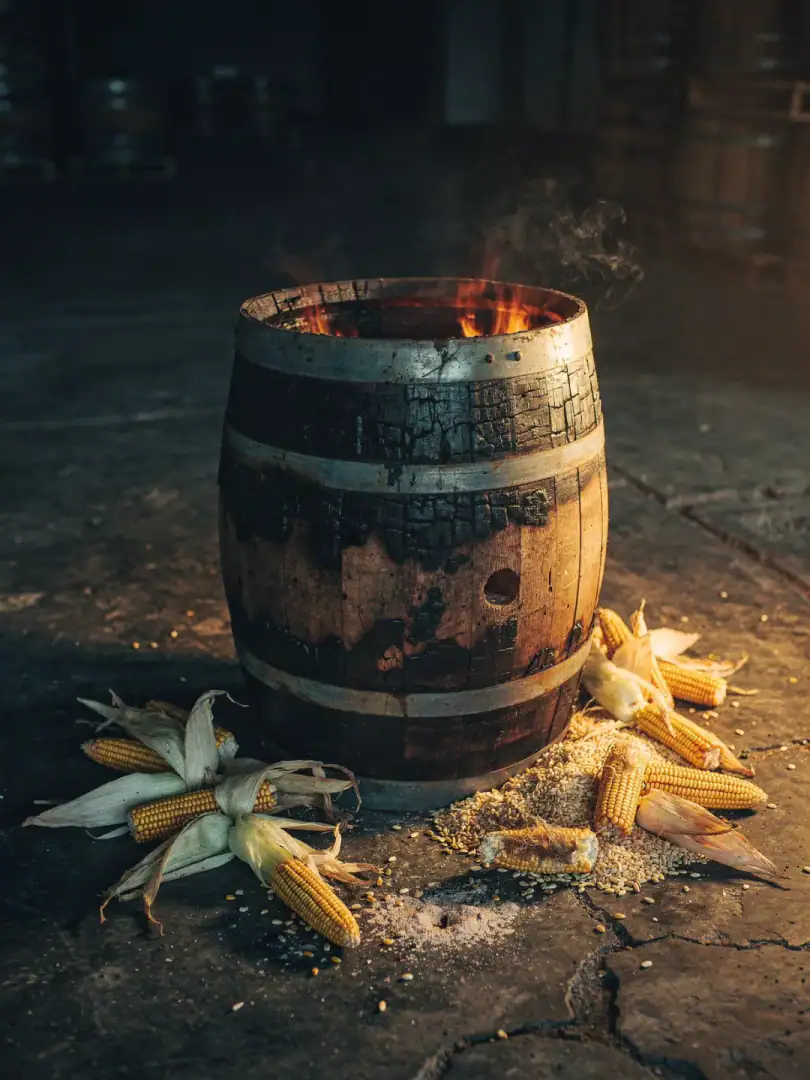
Another point concerns the barrel: bourbon ages exclusively in new, charred oak barrels. These barrels may not be used again for bourbon afterward. It's precisely these barrels that often end up later with Scotch or rum producers.
The barrel entry proof is also strictly regulated: the young whiskey may enter the barrel at no more than 62.5 percent ABV. This upper limit ensures enough water content remains in the distillate so that flavors from the wood can actually be extracted during maturation.
The mash bill: the recipe behind bourbon
The mash bill describes how much corn, rye, wheat, and barley go into the mash. Beyond the required minimum of 51 percent corn, each distillery decides the rest for itself. Most add rye or wheat, plus a bit of barley for fermentation.
A high-rye mash bill with a large rye content produces a spicier, sharper bourbon. A wheated mash bill with wheat instead of rye comes across as rounder and softer. Both recipes remain unmistakably bourbon as long as the corn content is correct.
Some distilleries maintain several mash bills at once to serve different product lines, for example a spicier variant for connoisseurs and a milder one for beginners. The exact recipe usually remains a trade secret and is only published in broad percentage ranges. Some craft distilleries, by contrast, deliberately publish their recipe openly to set themselves apart from the big houses.
Why bourbon tastes sweeter than Scotch
The high corn content is the main reason for bourbon's sweetness. Corn delivers significantly more fermentable sugar than barley. The new, charred oak barrel additionally imparts vanilla, caramel, and coconut notes to the whiskey. A used barrel no longer provides these notes in the same way.
Scotch, by contrast, is usually aged in already-used barrels, often former bourbon or sherry casks. These give off less fresh wood aroma. Combined with pure barley instead of corn, this results in a drier, less sweet base character.
Barrel size also influences the outcome: standard American barrels are generally smaller than many barrels used in Europe, which increases the ratio of wood surface area to liquid. This brings the whiskey into more intense contact with the wood, allowing it to pick up color and sweetness more quickly.
Straight Bourbon and plain bourbon
A Straight Bourbon must age for at least two years and contain no added coloring or flavoring. If aged under four years, the age must appear on the label. Plain bourbon without the term Straight may be aged for a shorter period or blended with other whiskey.
For beginners, it's worth checking the label. Straight Bourbon promises the purer, unembellished version. Plain bourbon is often cheaper but less consistent.
Bottled in Bond is another, even stricter category: it requires at least four years of aging in a government-supervised warehouse, production at a single distillery, and an exact bottling strength of 50 percent ABV. This old rule from the 19th century still counts as a seal of quality among connoisseurs today. Single Barrel and Small Batch are also distinct, clearly defined additional designations found on many labels.
Bourbon from Kentucky and bourbon from anywhere else
Contrary to popular belief, bourbon doesn't have to come from Kentucky. It may be distilled in any US state and still be called bourbon. Only the designation Kentucky Straight Bourbon actually requires production within Kentucky itself.
Kentucky nonetheless produces the largest share of the world's bourbon, thanks to limestone-filtered water and a climate with wide temperature swings. These swings make the whiskey interact more intensely with the wood and noticeably speed up maturation in the barrel.
Internationally known brands from Tennessee or Indiana also show that good bourbon quality isn't tied to a single landscape. What matters most is water, grain, and the craftsmanship of the respective distillery, not just the zip code on the label.