America's second path
Rye and Tennessee Whiskey
Besides bourbon, America has two other whiskey styles of its own: Rye, sharp and spicy from its high rye content, and Tennessee Whiskey, which tastes like bourbon but undergoes an additional filtering step. Both show just how varied American whiskey can be.
Rye Whiskey: at least 51 percent rye
In the USA, Rye Whiskey follows the same basic rules as bourbon, only with the main grain swapped. At least 51 percent rye replaces the corn. It is aged in new, charred oak barrels and distilled in the United States. Canada often calls its whisky Rye too, though without the same strict grain requirement.
Historically, before Prohibition, Rye was actually more popular than bourbon, especially on the East Coast. Only after the long era of alcohol prohibition did the style lose ground. In recent years, it has been gaining interest once again.
Straight Rye follows the same rule as Bourbon: at least two years of aging in new, charred oak barrels, with no added color or flavoring. Canadian rye, on the other hand, has no fixed minimum rye content, which is why the names may sound similar even though the whiskies themselves can taste quite different. So when you see a label marked Straight Rye, you can count on the same quality standard as with a Straight Bourbon.
How Rye Differs from Bourbon in Flavor
Where Bourbon tends to be round and sweet, Rye brings pepper, herbs, and a dry bite. This spiciness makes Rye especially popular in cocktails like the Manhattan or the Old Fashioned, where it holds its own against the other ingredients.
Anyone switching from Bourbon to Rye usually notices the difference right away. The first impression is less sweet and more edgy. Rye also stays pleasantly drinkable even when served cooler.
Some Rye distilleries go well beyond the legally required 51 percent, using mash bills with 95 percent rye or more. These high-rye recipes taste especially sharp and dry, while Ryes with a lower rye content lean closer to Bourbon in flavor.
Tennessee Whiskey: Bourbon with an Extra Step
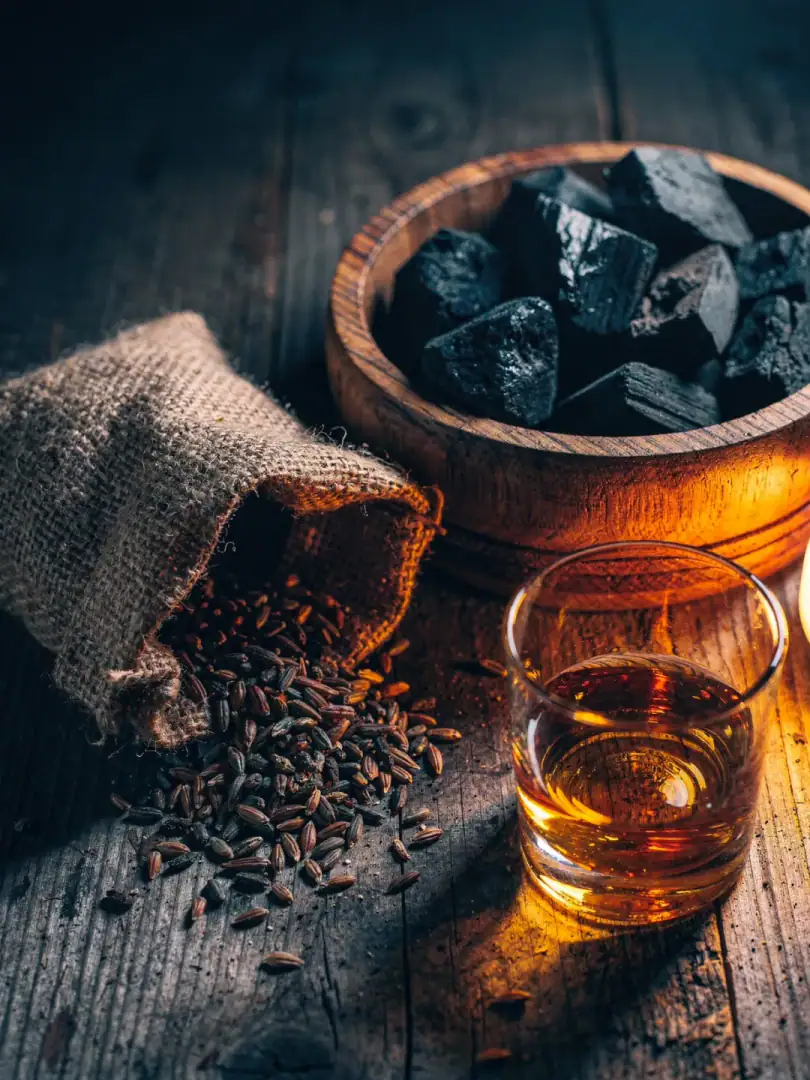
Tennessee Whiskey meets all the requirements of Bourbon. In addition, before barreling, it's filtered through a thick layer of maple charcoal. This step, known as the Lincoln County Process, makes the whiskey noticeably smoother, softening the rough edges of the young distillate.
This process is legally required for any whiskey that wants to call itself Tennessee Whiskey and is produced in Tennessee. One long-established distillery is exempt from this rule under a special exception.
Some distilleries still make the charcoal for the Lincoln County Process themselves, burning sugar maple wood in specially built pits. Depending on the distillery, this labor-intensive step can take several days. Others now buy ready-made charcoal from specialized suppliers to reliably meet the quantities they need.
Why Tennessee Whiskey still isn't called Bourbon
Legally, Tennessee Whiskey could be sold as Bourbon, since it meets all the Bourbon criteria. But distilleries in Tennessee deliberately insist on their own name. This makes the extra filtering step and their distinct origin visible.
For drinkers, this means Tennessee Whiskey is essentially Bourbon at its core. Thanks to charcoal filtering, it usually tastes a bit rounder and softer on the palate.
The distinct name is also more valuable for marketing and brand identity: Tennessee Whiskey sells internationally as a cultural product in its own right, whereas it would stand out less as merely a subcategory of Bourbon. So this decision is also economically motivated, not purely technical.
Two styles, two paths through the same landscape
Rye and Tennessee Whiskey show just how different American whiskey can be, even though both are built on the same basic rules. Rye starts with the grain, shifting the recipe toward spice. Tennessee Whiskey intervenes only after distillation, changing the texture through filtering.
Anyone who tastes both styles side by side quickly understands how much room the American regulations actually leave, despite their fixed percentages. This very flexibility explains why US whiskey shows so many different faces today.
The best way to understand both styles is to taste them back-to-back, on the same evening and in the same glass. This is the most reliable way to pick out the subtle differences in spice and texture, before the memory of the first sip fades.