Two Spellings
Whisky or Whiskey?
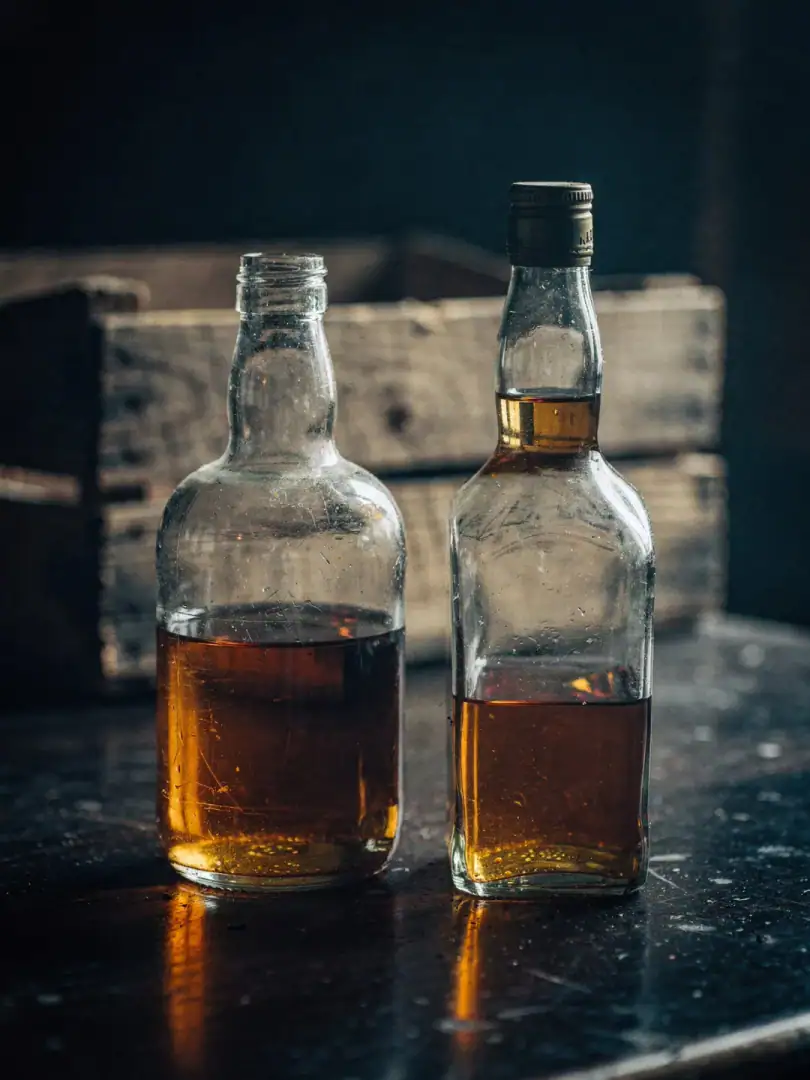
Sometimes the label reads Whisky, sometimes Whiskey. That's neither a typo nor a matter of taste, but a national border: Scotland and Canada write it without an e, while Ireland and the USA mostly write it with an e. Once you know the rule, you read every label with new eyes.
Where the two spellings come from
In the 19th century, English and Irish distillers spelled their spirit differently. Irish distilleries added an e to set themselves apart from Scottish competitors, who were considered inferior at the time. Many Irish emigrated to the USA in those years, carrying their spelling across the Atlantic with them.
Scotland stuck with whisky, no e. Canada followed the Scottish tradition, since its first distillers came from Scotland. What began as a 19th-century marketing dispute became a fixed rule. It still holds today, even though hardly anyone remembers the original quarrel.
Precise records from that era are rare, but the core idea survived across generations: the spelling became a quiet marker of identity, revealing a distillery's origin and self-image long before any law regulated the terms.
Who uses which spelling today
Scotland, Canada, Japan, and most countries outside the USA write Whisky. Ireland and the USA write Whiskey. There's one well-known exception: the US distillery Maker's Mark still sticks with Whisky without an e, out of respect for its Scottish roots.
Even in the plural, the word barely changes: Whisky becomes Whiskies, Whiskey becomes Whiskeys. Both forms are correct as long as they match the base spelling of the respective country. If you're ever unsure how to write it, just check the label on the bottle itself.
Japan is a special case: the Japanese whisky industry modeled itself closely on the Scottish example and adopted the e-less spelling along with the production methods. Major houses like Suntory or Nikka therefore consistently label their bottles as Whisky, even though Japan lies geographically and culturally far from Scotland.
Why it's not a matter of quality
The spelling says nothing about quality or taste. A Whiskey from Kentucky can be just as fine as a Whisky from Speyside. A simple blend is spelled the same way as an expensive single malt. The e question is about origin, not rating.
In German, Whisky has become the umbrella term for both spellings. Even when running text sometimes keeps the spelling of the country in question, say for a Bourbon from Kentucky, that changes nothing about what's inside the bottle.
Specialist retailers and tasting groups rarely organize their shelves by spelling anyway, but by style, region, or price. Whether you're after a peaty Islay Whisky or a mellow Bourbon, you'll find it regardless of whether the label carries an e or not.
A mnemonic for everyday use
If you want to remember the rule, think of the E in Ireland and in United States. Both words contain an E, and both countries write Whiskey with an e. Scotland, Canada, and Japan have no E in the same spot. That's why they stick with Whisky.
This mnemonic is no substitute for legal regulation, but it helps out in the shop or when reading a menu. The stations that follow reveal what really lies behind the names. First up: the grain from which every whisky is made in the first place.
For Canada, the same mnemonic works twice over: neither Canada nor Kanada contains an E in the crucial spot, and indeed the country consistently writes Whisky. Once you've internalized the rule, you won't have to guess at the next shelf.
Why even the lawmakers recognize both forms
The EU Spirit Drinks Regulation, which applies across Europe, explicitly uses both forms in its English version: whisky or whiskey. The legislator didn't intend to favor either spelling. Both recognized traditions were meant to be treated equally. Member states then implement the rule nationally in their own language.
For Germany, that means: legally, neither Whisky nor Whiskey has the advantage on a label. What matters is only that the other requirements are met, such as the minimum maturation period of three years in wood and the minimum strength of 40% ABV. The spelling remains tradition, not law.
Other international trade agreements also tend to adopt both spellings side by side, to avoid friction among the countries involved. For consumers, that means: whether you lean toward Whisky or Whiskey while shopping, you're never making a legal mistake, as long as the bottle itself is correctly labeled.