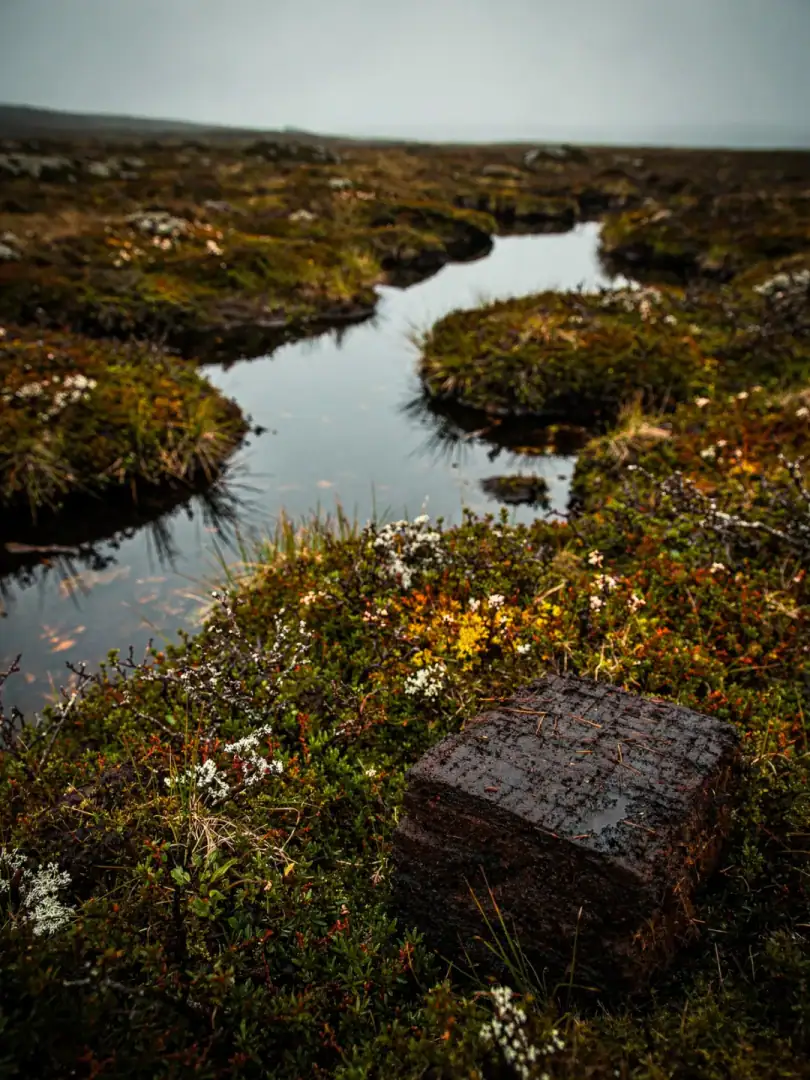
Bogs as carbon stores
Peat & climate protection
Bogs store more carbon than any forest. When peat is cut and burned, this stored carbon is released, a fact the whisky industry increasingly discusses openly rather than keeping quiet about.
Why bogs matter for the climate
Intact bogs bind carbon in growing peat over millennia, often more per area than comparable forest land. Worldwide, bogs are estimated to store roughly twice as much carbon as all the world's forests combined, even though they cover only a fraction of the land area.
When a bog is drained or excavated, this effect reverses: the previously bound carbon returns to the atmosphere as carbon dioxide, and the bog stops forming new peat.
What peat extraction means for whisky
Compared to horticulture or energy production, the whisky industry uses only a small portion of the peat extracted worldwide, but is heavily discussed because of its visibility. Larger distilleries have published their own studies on peat consumption and formulated reduction targets.
Some Scottish maltings now source peat from already disturbed land in need of restoration rather than from intact bogs, in order to reduce the impact on undisturbed ecosystems.
Paths to less impact
Some distilleries are testing whether they can achieve the same smoky character with less peat per batch, for instance through longer smoking times with smaller quantities or by deliberately blending different phenol sources. Others fund bog restoration to offset their own consumption.
Hardly any distillery wants to give up peat entirely, because it shapes the flavor style of many well-known whiskies. The compromise usually lies between conscious, reduced use and offsetting measures elsewhere.
What drinkers notice
For the taste in the glass, the climate discussion changes nothing at first, a whisky made with reduced peat use doesn't automatically taste different from one made using traditional methods. The difference lies more in how the distillery achieves its smoky character, not in how strong it turns out.
Some brands now openly communicate how much peat they use and which offsetting measures they fund, similar to what other food industries have long done. Anyone who wants to shop consciously will increasingly find this information on the websites of larger distilleries.
Bog restoration as a countermeasure
Alongside reduced peat use, some organizations and distilleries rely on active rewetting of damaged bogs, a process in which drained land is deliberately flooded again so that new peat can form. Drained bogs no longer bind new carbon. They actually continue to actively release carbon dioxide as long as they stay dry, because the upper peat layers then keep rotting away. Rewetting stops this process and can, in the best case, even reverse it, although a fully recovered bog takes decades.
Scottish conservation programs such as the Scottish government's Peatland ACTION program support such projects financially and technically, sometimes with involvement from the whisky industry. For distilleries, this is a way to offset their own peat consumption without having to give up the characteristic smoke in their whiskies, even though critics note that offsetting doesn't fully compensate for the original impact.
One hectare of intact bog stores enormous amounts of carbon. Drained bogs worldwide cause a noticeable share of all greenhouse gases from land use. Scotland itself is covered by large areas of moorland, far more than forest. These figures explain why conservationists look closely at the topic of peat.
A single bottle of whisky only requires a few kilograms of peat. Compared to the amount used for garden soil or energy production, whisky production's share remains small. Still, it often ends up in the spotlight, because the smoke in the glass seems so directly tied to the bog. This very visibility makes transparency more important for distilleries than sheer volume figures. Consumers can follow this development with simple questions: Where does the peat come from? Is there any information on offsetting measures?