Words for Aromas
Flavor Wheel & Terminology
A scent is quickly recognized but hard to name. A flavor wheel organizes smells into groups and gives you the words that express exactly what you're picking up in your nose right now.
What a Flavor Wheel Does
A scent is hard to put into words when it isn't assigned to a category, and this is exactly where the flavor wheel comes in: at the center are broad families like fruity, floral, cereal, smoky, or woody, and further out are individual, specific terms. "Fruity" thus becomes, for example, apple, pear, citrus, or dried fruit. This structure helps because the brain often perceives smells only vaguely, but recognizes them much more easily once it's presented with a limited list of possible words.
This idea was borrowed for whisky from wine tasting and adapted to typical whisky aromas. Since the late 1970s, Scottish tasters have used such wheels to systematically capture and compare flavor impressions, rather than simply saying "good" or "bad".
The Major Aroma Families at a Glance
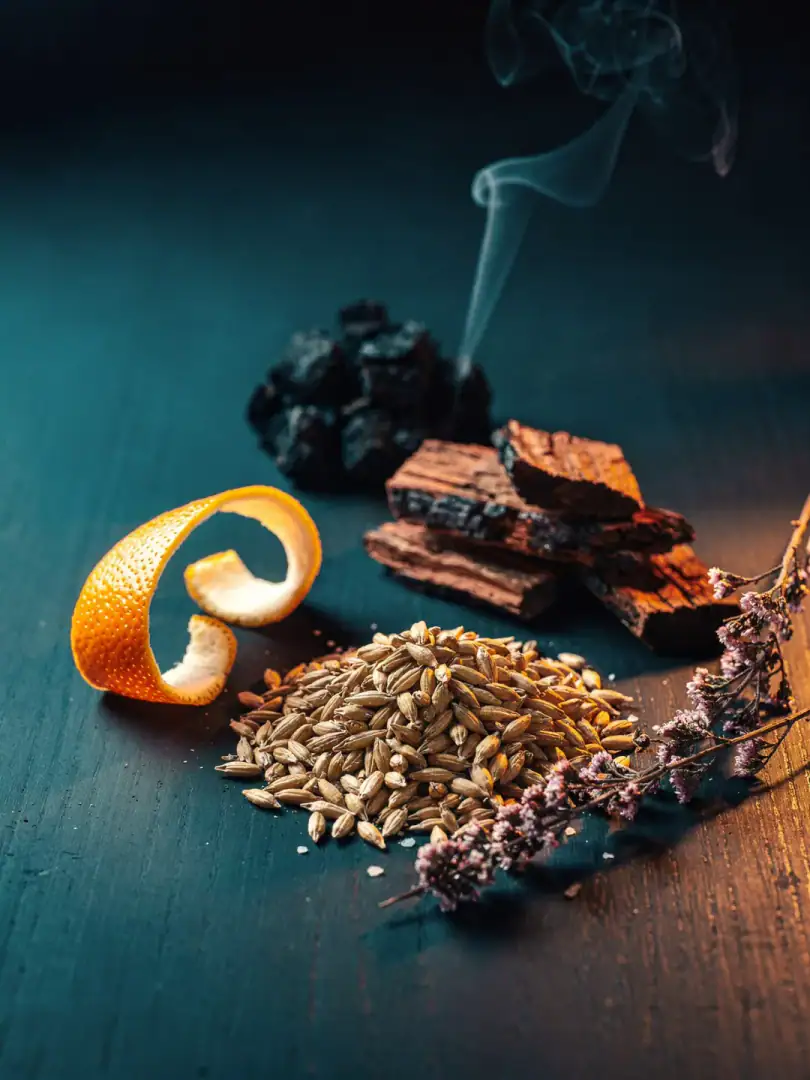
Fruity notes range from fresh apple and pear through citrus to dried fruit like raisins or figs, often a sign of sherry casks. Floral tones recall heather, hay, or freshly cut grass, typical of lighter, younger whiskies. Cereal notes, such as biscuit, muesli, or fresh bread, come directly from the mash and are often still clearly recognizable in young malt.
Smoky and medicinal notes, from campfire to tar to iodine and sticking plaster, almost always come from peat burned during malting. Woody notes like vanilla, coconut, caramel, or cedar reveal a lot about the cask: American oak tends to bring vanilla and coconut, European oak tends toward spice and dark dried fruit.
When Something's Off: Undesirable Notes
Not every scent in the glass is welcome. Sulfury notes, reminiscent of burnt matches or rubber, often arise during distillation and are meant to fade over time in the cask, but sometimes linger. Green, grassy notes suggest a very young new make that hasn't had enough maturation time to round out. These terms belong on the flavor wheel too, because tasting means naming what's beautiful as well as recognizing faults.
Once you've consciously registered these families, you'll recognize them much faster afterward. The brain mainly needs a name it can attach to a scent.
Finding Your Own Terms Instead of Just Repeating Them
Treat the flavor wheel as a starting point, not a rulebook. If a scent reminds you more of fresh hay from your neighbor's farm than of the printed word "heather," your own term is the better one, because it helps you recognize the whisky again later. More important than using the exact correct technical term is using the same internal language at every tasting.
Go ahead and write down your own associations, even if they sound unusual. Over time, this becomes a personal flavor wheel that works more reliably for you than any printed template.
Comparing Aromas Across Multiple Whiskies
A flavor wheel only truly shows its value once you taste several whiskies back to back and compare their families directly. If you note down which families dominate in each glass, fruity or more woody, smoky or floral, a pattern quickly emerges. Some distilleries or regions will keep turning up in the same families for you, while others surprise you every time.
These comparisons are often more revealing than any single tasting on its own, because they show which flavor families genuinely appeal to you. If you notice that smoky and woody notes keep winning you over while floral tones leave you cold, you've found a real compass for your next bottle purchase, quite independent of labels or price tags.
Keep a simple list where you jot down the two or three dominant families for each whisky. After ten or twenty entries, a clear profile almost always emerges, showing you which direction your next purchases should take.