Color Often Deceives
Reading Color
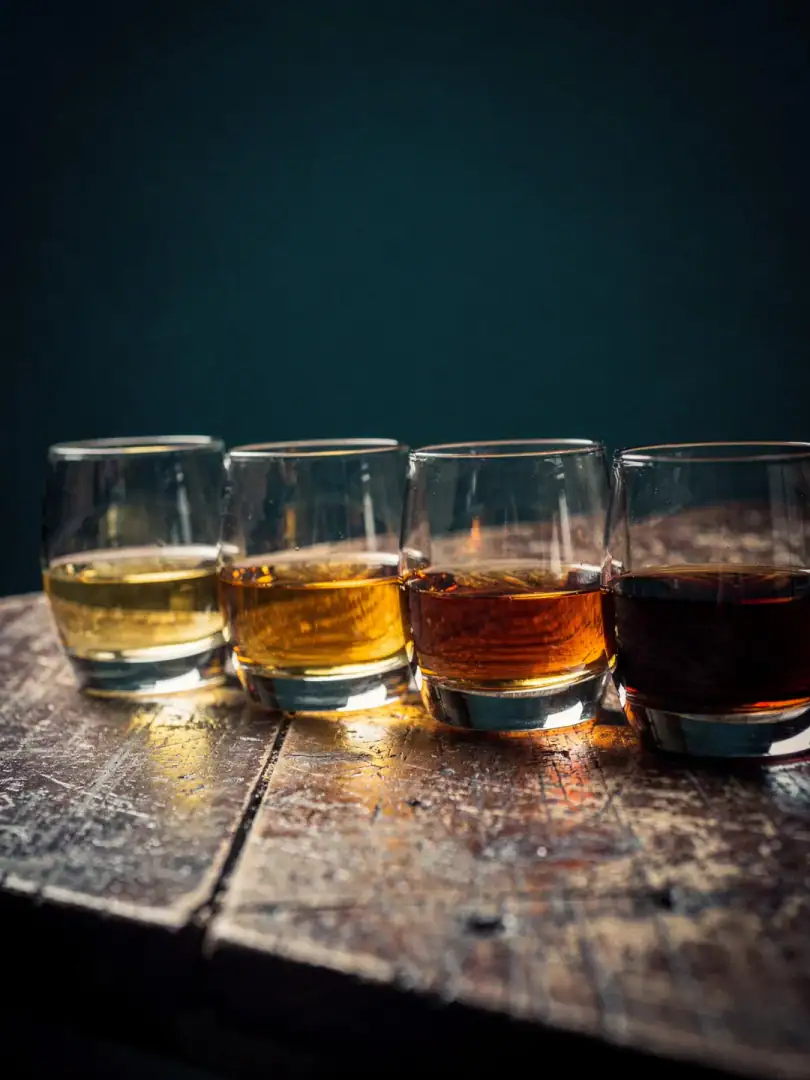
A dark whisky seems mature and robust, a pale one seems younger and more delicate. This rule is wrong more often than it's right, because a single permitted additive can change the color without changing the contents much at all.
What Color Really Reveals
Color comes almost entirely from the cask. Young whisky, fresh off the still, is crystal clear. Only the wood gives it color, and how much depends heavily on which cask was used. A cask that previously held bourbon tends to impart a light gold hue. A sherry cask made of European oak colors much darker, often toward mahogany or reddish-brown, because its tannins are more potent.
Maturation time also plays a role, but unreliably: a twenty-year-old whisky from a tired, often-used cask can remain paler than a five-year-old from fresh, heavily charred oak. Color alone therefore never tells you reliably how old a whisky is or what kind of cask it matured in.
E150a: The Only Permitted Additive
For Scotch Whisky, Scottish regulations, the Scotch Whisky Regulations 2009, permit exactly one additive: plain caramel coloring, listed in food law as E150a. No flavoring, no sweetener, no other coloring, just this one agent, and even that solely for color consistency. The reason is simple: two casks of the same whisky never mature exactly the same way, yet customers still expect the same color from bottle to bottle.
E150a barely affects flavor in any noticeable way, but it strongly affects first impressions. A whisky that would otherwise look pale and young can suddenly appear old and rich with just a few drops of coloring. That's exactly why experienced tasters follow this rule: look at the color, but don't blindly trust it.
Bourbon Does It Differently
In the US, a stricter rule applies to "straight" Bourbon and "straight" Rye. Federal regulation 27 CFR Part 5 prohibits any additives there, including coloring. Whatever color you see in a genuine straight Bourbon comes entirely from the cask, with no help at all. That explains why some young Bourbons appear surprisingly dark: the new, heavily charred oak that US law requires for Bourbon releases a lot of color quickly.
Anyone familiar with both worlds reads color differently: in Bourbon, it's a fairly honest indicator of cask and maturation. In Scotch Whisky, it can be too, but doesn't have to be, as long as E150a is permitted.
How to Properly Assess Color
Hold the glass against a bright, neutral background, ideally daylight without direct sun, and tilt it slightly so you can see the edge of the liquid. There, the hue often shows more clearly than in the middle of the glass. Describe what you see in simple terms: straw yellow, golden yellow, amber, copper, mahogany, rather than just saying "light" or "dark".
Use color as a first, cautious clue, not as a verdict. A pale whisky can be complex, and a dark one can be thin. The real work only begins with the nose.
Why Color Still Sets Strong Expectations
Color still has a powerful effect on expectation, because many people unconsciously orient themselves by wine when they first glance at a glass, where darker color is often associated with greater maturity and strength. This is exactly the expectation distilleries cater to when they use E150a to ensure a consistent color from bottle to bottle, regardless of the actual maturity level in any given cask.
For you as a taster, this mainly means one thing: don't let a dark color lure you into higher expectations before your nose and palate have even checked what's really in the glass. A second glance at the label, checking whether it mentions natural color or not, often reveals more than color alone.
Some independent bottlers actively advertise that they forgo caramel coloring, precisely because many customers now appreciate this transparency. That doesn't change the legality of E150a, but it does show that color has long since become a deliberate marketing decision in the industry, not just a random byproduct of maturation.