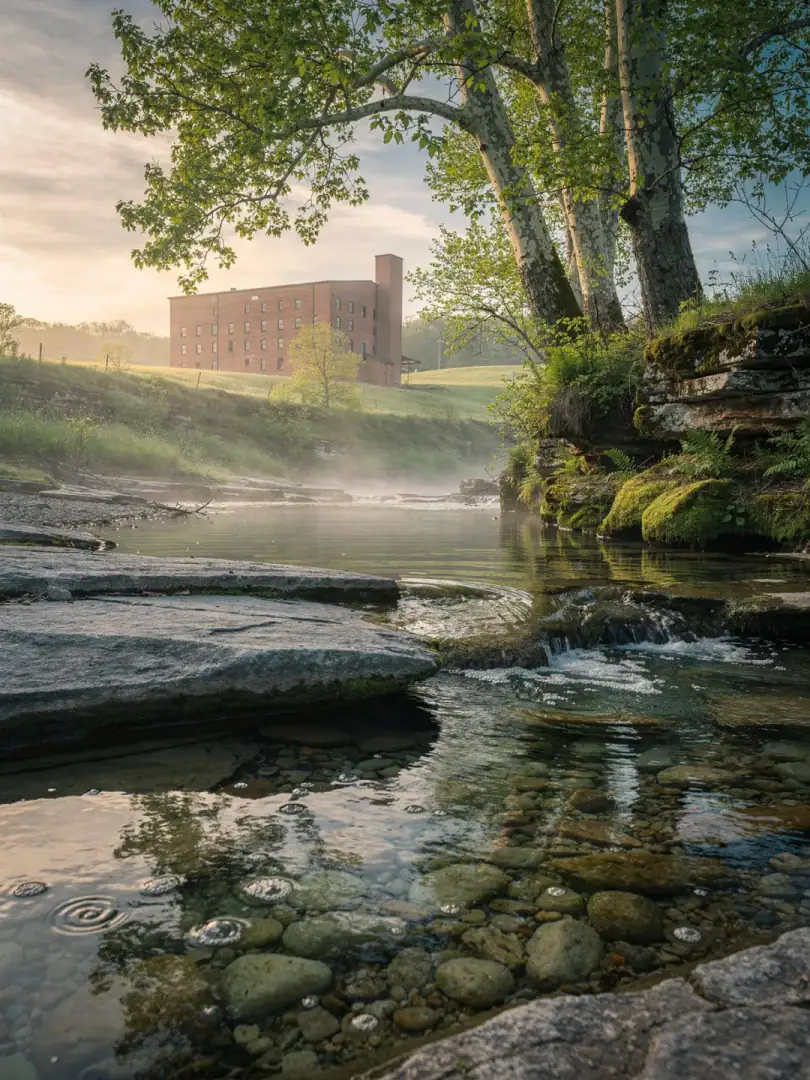
Limestone & Rivers
Water & Climate
Beneath the green hills of the Bluegrass region lies a thick layer of Ordovician limestone, more than 400 million years old. Rainwater seeps through it, dissolving calcium and magnesium from the rock. In the process, it loses its iron, as the rock filters it out. This limestone layer underlies nearly the entire Bluegrass region and in places runs many meters deep.
For distillers, this is worth its weight in gold. Iron-rich water turns whiskey an unattractive dark color and alters its flavor. Buffalo Trace in Frankfort draws its water partly straight from the Kentucky River, which flows past the distillery, and partly from springs in the limestone below.
The Salt River near Bardstown and the Elkhorn Creek further north also rise from the same limestone bedrock. Historically, their water powered the mills and steam engines of early distilleries. Today it mainly supplies the minerals a vigorous fermentation needs.
Kentucky's climate is a second water factor—not inside the barrel, but around it. Summers here turn hot and humid, while winters grow cold. This shift pushes the whiskey deep into the wood and back out again. Scotland rarely sees such swings, which is why bourbon in Kentucky matures faster and more intensely than many a Scotch. The soils also respond to this shift, retaining water less well in summer than in spring.
Anyone visiting the distilleries between Frankfort and Lawrenceburg will walk past one of the small limestone creeks that wind through Bluegrass country almost everywhere. Without them, there would be no whiskey industry of this scale here.