Column & Purity
Distillation & Rectification
It all starts with a mash of milled grain, water, and yeast. It ferments for several days, producing a weak alcohol of just a few percent. That's not enough for vodka: only rectification turns it into an almost pure, flavor-neutral alcohol.
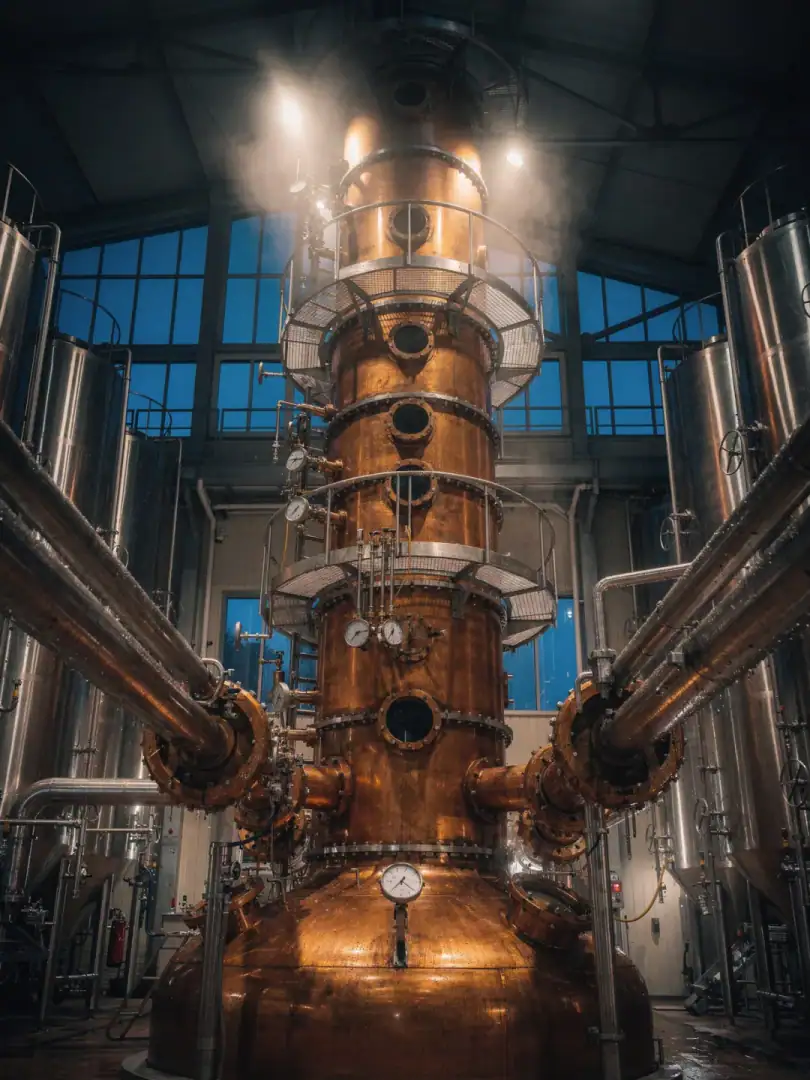
Modern distilleries use tall columns made of copper and steel, through which the alcohol vapor rises and condenses again and again. Each pass separates out unwanted compounds more thoroughly, until in the end a distillate of well over ninety percent alcohol remains. Three Sixty, for instance, advertises quadruple distillation for exceptional purity, according to the producer.
Afterward, the high-proof alcohol is diluted with water to drinking strength. The EU requires a minimum of 37.5 percent for vodka, and many German brands sit at exactly this level or at 40 percent. Three Sixty, for example, sells its vodka at 37.5% ABV.
This is what sets vodka apart from classic Korn spirit, which is often distilled only once and therefore retains more of its grain character. Vodka, by contrast, is meant to taste as neutral as possible. The column deliberately smooths away the rough edges that a simple distillate would still have.
In Berlin, where Three Sixty is based, column distillation has long been standard practice in the industry. Small Korn distilleries in the Ruhr Valley, on the other hand, often still distill the traditional way and in smaller batches, using pot stills instead of tall columns. Both approaches are permitted, as long as the required minimum strength is reached in the end. Which method a distillery chooses remains ultimately its own decision.