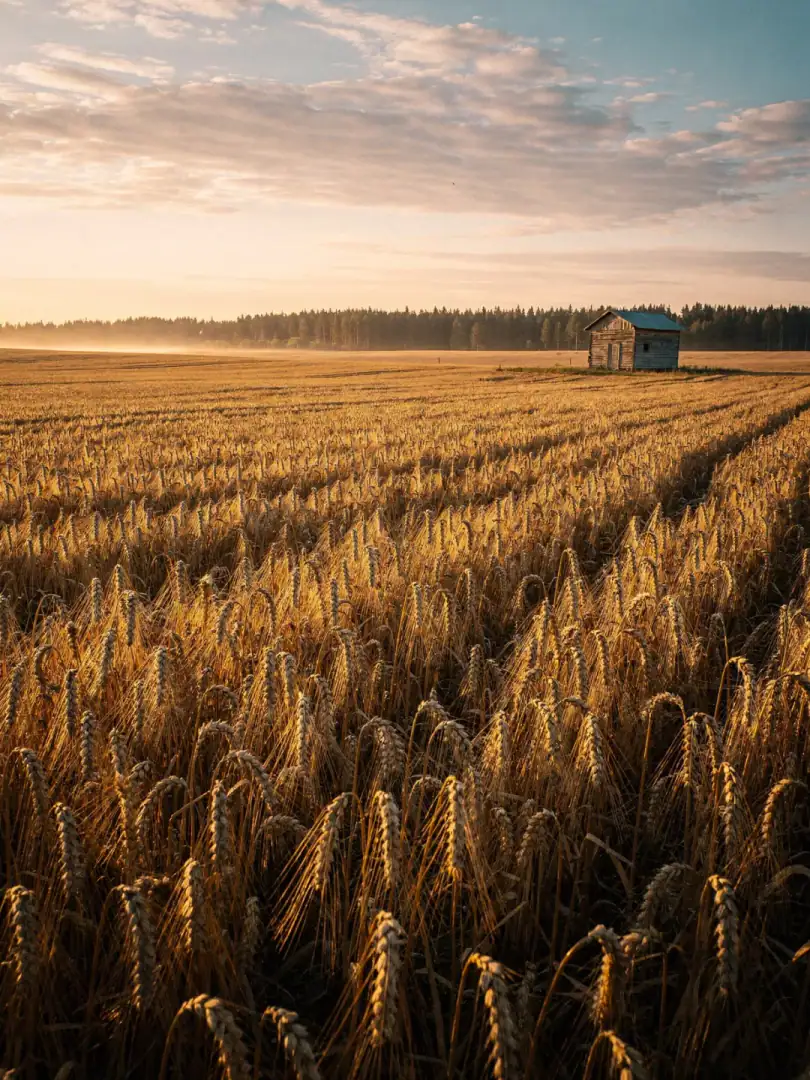
Barley Under the Midnight Sun
Raw Material
Around Ilmajoki, in the heart of Etelä-Pohjanmaa province in western Finland, lie the flat grain fields that supply Koskenkorva's barley. In late summer, golden ears of grain sway toward the horizon here, barely interrupted by a tree or hill. Wheat and oats grow alongside the six-row barley that Altia uses for its vodka.
Six-row barley produces more kernels per ear than the two-row variety commonly used for beer, though the kernels themselves are smaller, and it yields more starch. That starch is exactly what distillation needs: through malting and fermentation, it becomes the alcohol that the columns in Ilmajoki later purify.
Finland's short growing season allows barley only about a hundred days to mature. Because the summer sun barely sets at these latitudes, plants grow almost around the clock, storing an unusually large amount of starch during this time. Despite the short season, yield per hectare remains competitive.
In many places, the soil beneath these fields is heavy, fine-grained clay, formed on what was once the seabed along Finland's Baltic coast. It holds water well and releases it slowly to the barley during dry summer weeks. This heavy clay would suit rye or potatoes, more common elsewhere in Finland, less well, but it's ideal for barley.
Wide, flat expanses define the landscape around Ilmajoki, with barely a hill breaking up the long rows of fields. The distance from harvest to distillery is usually short on these flat fields, with many farms just a few kilometers away, short journeys that keep the raw material fresh.
Dark, humus-rich loam, cultivated for generations and enriched with organic matter.
The root: Here the barley germinates and sends out its first shallow roots.