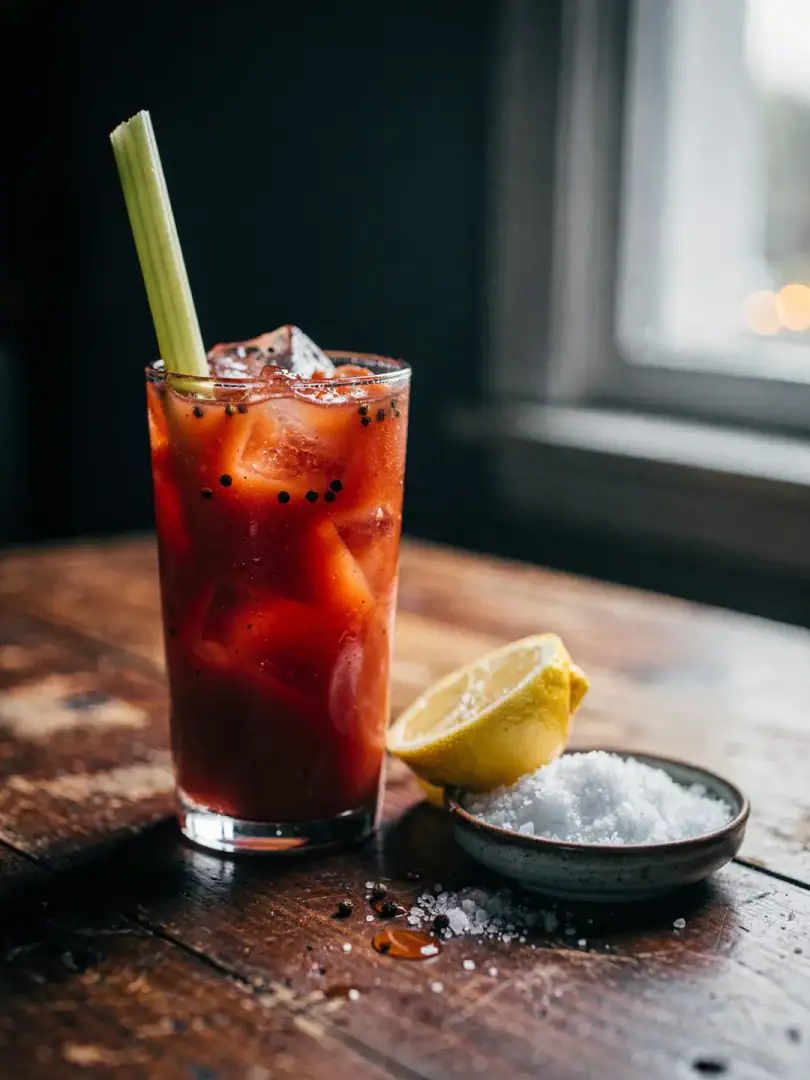
A hearty brunch drink
Bloody Mary
Few cocktails divide opinion quite like the Bloody Mary: savory, spicy, and made with tomato juice instead of sweetness. It emerged sometime in the 1920s or 1930s, somewhere between Paris and New York. This section covers its history, the classic recipe in cl, and the most important variations.
Where the Bloody Mary comes from
The origin of the Bloody Mary is still disputed today, which is hardly surprising for such an old drink. The most common story names bartender Fernand Petiot, who first worked at Harry's New York Bar in Paris and later moved to the King Cole Bar at the St. Regis Hotel in New York. Petiot is said to have first mixed just vodka and tomato juice around 1920 in Paris, with no spices at all.
Only in New York, so the story goes, did he add Worcestershire sauce, lemon juice, pepper, and salt in the 1930s, turning the simple mixture into the spicy drink we know today. Where the name comes from is also unclear: some point to the English queen Mary I, nicknamed "Bloody Mary" for her persecution of Protestants, others to a bar acquaintance named Mary.
The classic recipe in cl
A classic Bloody Mary needs 5 cl vodka, 10 cl tomato juice, and 1 cl fresh lemon juice as its base. To that add a few dashes of Worcestershire sauce, one or two dashes of Tabasco, a pinch of celery salt, and freshly ground black pepper. All the ingredients are stirred over ice cubes in a tall glass, not shaken, so the tomato juice doesn't foam up too much.
The classic garnish for a Bloody Mary is a whole celery stalk, which doubles as an edible stirrer. Many bars also add an olive, a small pickle, or a lemon wedge on the rim. How spicy and how savory the final mix tastes can be finely tuned via the amount of Tabasco and pepper.
Why tomato juice and vodka work together
Tomato juice naturally brings sweetness, acidity, and a slightly salty umami that tastes far more robust than plain fruit juice. Because vodka has almost no character of its own, it doesn't change that flavor, it just raises the alcohol content and the texture. With an aromatic spirit like gin or whisky, on the other hand, the flavor would shift noticeably.
The spices act like an amplifier: Worcestershire sauce brings umami and light acidity, Tabasco brings heat, celery salt brings an earthy note. Together they create a flavor profile that resembles a hearty soup more than a sweet cocktail. That's exactly what makes the Bloody Mary a popular drink in the late morning or at brunch, when other cocktails would feel too sweet.
Virgin Mary and other variations
Anyone skipping the alcohol can order a Virgin Mary: the same mix of tomato juice and spices, just without the vodka. Flavor-wise, the drink stays surprisingly close to the original, since the vodka barely contributes any flavor of its own anyway. That just goes to show how much the Bloody Mary lives off its spices rather than its spirit.
There are plenty of regional variations: in Canada, a version made with clam broth instead of tomato juice is called a "Bloody Caesar," while in Mexico chili or lime juice is often added. Some bars now serve the Bloody Mary with elaborate garnishes like small skewers of bacon or cheese, though that doesn't change the basic recipe.
Bloody Mary the morning after: the hangover-cure myth
Many people consider the Bloody Mary a cure for a hangover after a heavy night out. There's no evidence for that: alcohol only breaks down in the body over time, and no drink speeds that process up. Tomato juice does at least provide some fluid and salts back that the body loses through alcohol, which may ease a few individual symptoms at best.
Anyone drinking it in the morning anyway should think of it as a savory, spicy drink rather than medicine. The Bloody Mary remains, first and foremost, a cocktail with alcohol in it, not a home remedy. If you're feeling rough, water, rest, and time will help more than another drink.