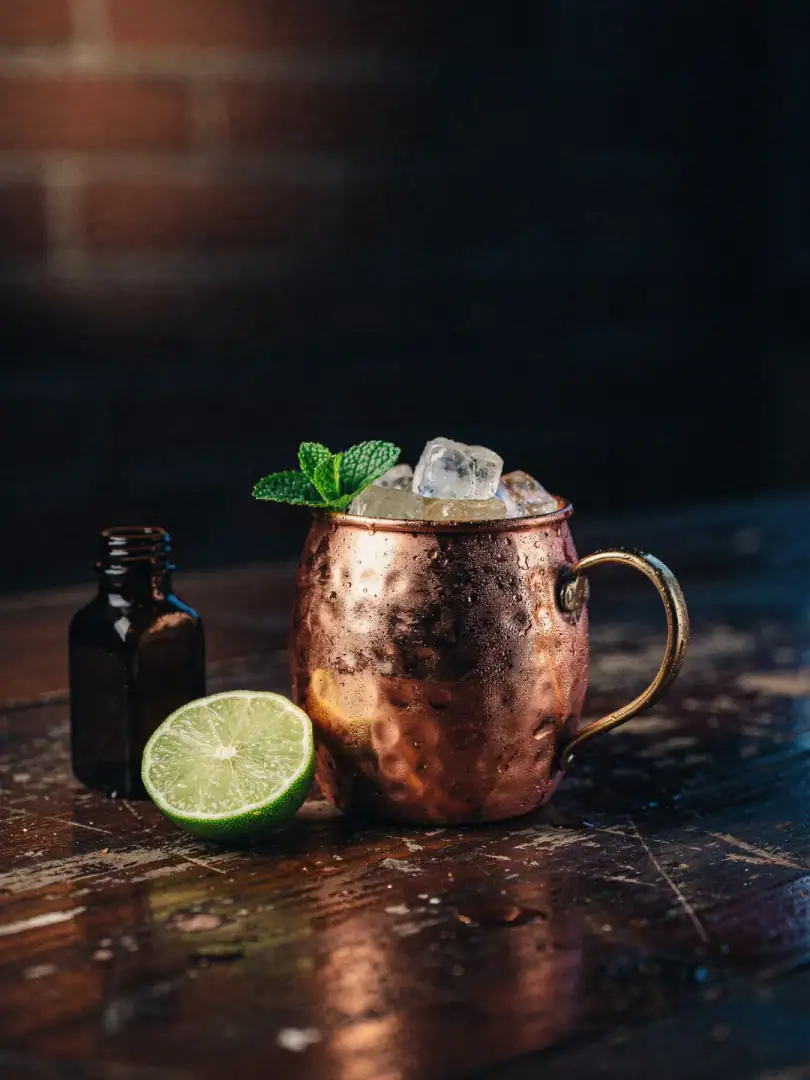
Copper mug since 1941
Moscow Mule
The Moscow Mule brought vodka into American bars back in 1941, and it's still served today in its signature copper mug. The mix of vodka, lime, and ginger beer sounds simple, but it comes with its own marketing story. This section covers how the drink came about and how to mix it properly.
How the Moscow Mule was created in 1941
The story begins in New York, shortly before the US entered World War II. John G. Martin worked for the spirits importer Heublein, which held the US distribution rights for Smirnoff vodka, but almost nobody in America knew or bought vodka. Jack Morgan, owner of the Hollywood bar "Cock 'n' Bull," was at the same time sitting on a surplus of homemade ginger beer that wasn't selling well.
According to legend, the two met at a bar in New York and decided to combine their two slow-moving products: vodka, ginger beer, and a bit of lime juice. Copper mug maker Sophie Berezinski is said to have been trying to offload her handcrafted copper mugs at around the same time. That's how the drink and the vessel came together and were marketed as a pair, with photo campaigns run in bars across the US. The success finally made vodka properly known in America.
Why the copper mug belongs with the drink
Copper conducts cold particularly well, which is why a Moscow Mule in a copper mug feels noticeably colder than the same drink in an ordinary glass. The mug quickly fogs up with condensation on the outside, which makes the drink instantly recognizable. Historically, the copper mug was mainly a marketing tool that set the Moscow Mule apart from other vodka drinks of the time.
One thing matters for preparation: the vodka should never come into direct, prolonged contact with bare copper, since small amounts of copper can otherwise dissolve into the drink. That's why modern copper mugs usually have an inner lining of nickel or stainless steel. Without a copper mug, the drink tastes just as good in an ordinary highball glass, you just lose the look and the chill factor.
The classic recipe in cl
A Moscow Mule doesn't need much: 5 cl vodka, 1.5 cl freshly squeezed lime juice, and about 10 cl ginger beer. The mug or glass is filled with ice cubes first, then the vodka and lime juice are added. Only after that is it topped up with ginger beer, so the carbonation is preserved and the drink doesn't go flat from stirring too early.
A quick stir with the bar spoon is enough to combine everything gently without knocking out the carbonation. Garnish comes in the form of a lime wedge and a sprig of mint, which brushes past the rim as you drink and adds a fresh aroma. For extra heat, some add a thin slice of fresh ginger to the glass as well.
Ginger beer, not ginger ale: the difference matters
Many people confuse ginger beer with ginger ale, but there's a clear difference between the two. Ginger ale is usually a mild, heavily filtered soda with a light ginger flavor. Ginger beer is traditionally lightly fermented, tastes distinctly sharper, and often brings a noticeable bite on the finish that gives the Moscow Mule its kick.
With regular ginger ale, the drink becomes noticeably milder and sweeter, which isn't wrong, but it does drift from the original flavor. The same rule applies to non-alcoholic ginger beers as to the vodka itself: the clearer and sharper the base, the better it carries the lime. Anyone who tries both side by side will immediately taste why the choice of ingredient isn't just a detail.
Kentucky Mule, Mexican Mule, and relatives
The name "Mule" has come to stand for an entire drink formula: spirit, ginger beer, and lime, served over ice. Swap the vodka for bourbon and you get the Kentucky Mule; for tequila, the Mexican Mule; for Irish whiskey, the Irish Mule. All of them follow the exact structure of the Moscow Mule, only the base spirit changes.
Gin has its own version too, the Gin-Gin Mule, which also adds fresh mint. The same rule applies to all these relatives as to the original: the clearer and sharper the ginger beer, the better it carries the spirit in question. Once you've mastered the Moscow Mule, the same technique lets you easily mix the whole drink family.