Hearty and Simple
Cured Pork, Bread, and Lard
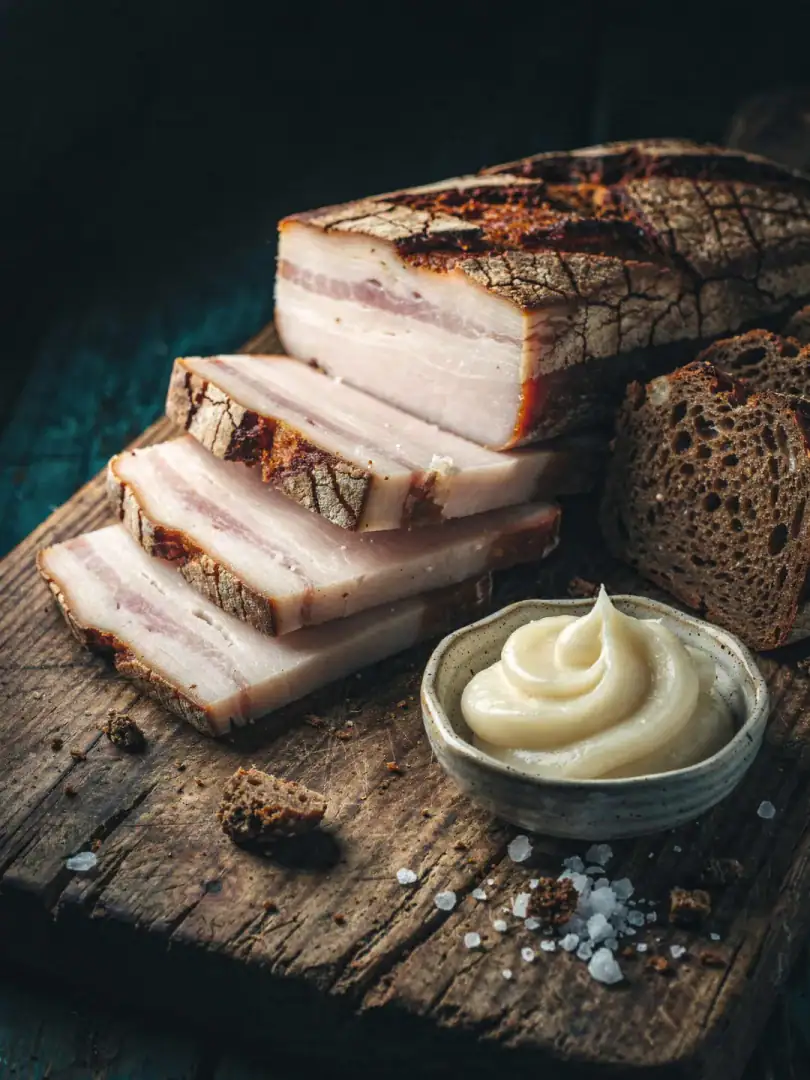
Smoked cured pork, dark rye bread, and lard with cracklings form the simple counterpart to caviar on the vodka table. This stop shows why these hearty ingredients are so popular in Poland, Russia, and Ukraine.
Cured pork (salo) as a staple food
In Ukraine and parts of Russia, raw, salted back fat is called salo. It's cut into thick strips, sometimes smoked or rubbed with garlic and paprika, and eaten raw, often straight on a slice of dark rye bread. A good strip stays firm but almost melts on the tongue. A sharp knife is all it takes to slice it, nothing more is needed.
Salo was long regarded as a stockpile for harsh winters, since pure fat keeps for months without refrigeration. Today it's less an emergency reserve than a prized accompaniment that, thanks to its high fat content, delivers the same buffering effect against alcohol as fatty fish. In some families, salo is still salt-cured at home to this day.
Why rye bread belongs on the table
Dark rye bread, often called black bread, has a dense crumb and a slightly tangy flavor from the sourdough. It absorbs fat and salt well and provides carbohydrates that fill the stomach before the alcohol takes effect. White bread performs this job far less effectively. A thick slice is usually enough to last the whole evening.
In Russia, a simple ritual is common: a slice of black bread is briefly held up to the vodka to smell before drinking. This is followed by a bite of the same bread, sometimes spread with a thin layer of mustard or sprinkled with salt. Some swear by this sniffing ritual more than by any other accompaniment.
Schmalz with cracklings
Schmalz, rendered pork fat studded with crispy cracklings, is spread cold on bread and often refined with onions, apples, or marjoram. This preparation is common in Poland, Germany, and much of Eastern Europe, differing from region to region mainly in the seasoning used. Fresh schmalz can be recognized by its pale, creamy color. Dark or grainy patches in the jar are a sign of poor quality.
Like speck, schmalz mainly supplies fat that buffers alcohol in the stomach. Paired with rye bread, it makes a simple, inexpensive combination that's never missing from a traditional vodka table, whether at a celebration or a spontaneous get-together with friends. A single jar of schmalz is often enough for an entire round.
A hearty foundation for long evenings
Speck, bread, and schmalz cost little and can be served without a fridge or a stove. That's precisely what makes them the backbone of almost any improvised zakuski spread when there's no time for elaborate dishes. A complete plate can be ready in just a few minutes. Elaborate cooking skills simply aren't needed for this part of the table.
Anyone planning a vodka evening should treat these three ingredients as the basic framework, adding fish, pickled vegetables, or, on festive occasions, caviar only afterward. The final stop on this journey shows how all of this comes together into a cohesive evening. Without this basic framework, any festive addition quickly feels out of place.
Regional differences in bread and fat
In Poland, schmalz is often refined with marjoram and diced apple. In Russia, salo usually stays plain, at most rubbed with garlic. Both versions share the same basic idea: simple fat on firm bread. Which version tastes better ultimately comes down to habit.
The bread also differs slightly: Polish rye bread often tastes milder than the robust Russian black bread. For your own table, any good loaf fresh from the oven will do, as long as it's firm enough to spread on. A bakery with an Eastern European range is often the best source. Without this bread, the whole spread lacks its proper foundation.