Nobility and Estate Distilleries
The Nobility's Privilege
In Poland-Lithuania and Russia, distilling vodka became an exclusive privilege of the landed nobility for centuries. If you owned an estate, you could distill and sell; if you didn't, you had to buy. This right, known as propination, shaped agriculture and society well into the 19th century.
What the Right of Propination Meant
From the 16th century onward, noble landowners in Poland-Lithuania and Russia secured a privilege known as the right of propination: the exclusive right to distill alcohol on their own land and sell it to the peasants living there. For the nobility, this was doubly lucrative, since surplus grain and, later, potatoes from their own farms could be turned into vodka instead of spoiling, and buyers were practically guaranteed by manorial law. In many places, peasants living on noble land were forbidden from distilling their own alcohol and were forced to buy it at the manor's tavern.
Estate Distilleries as an Economic Engine
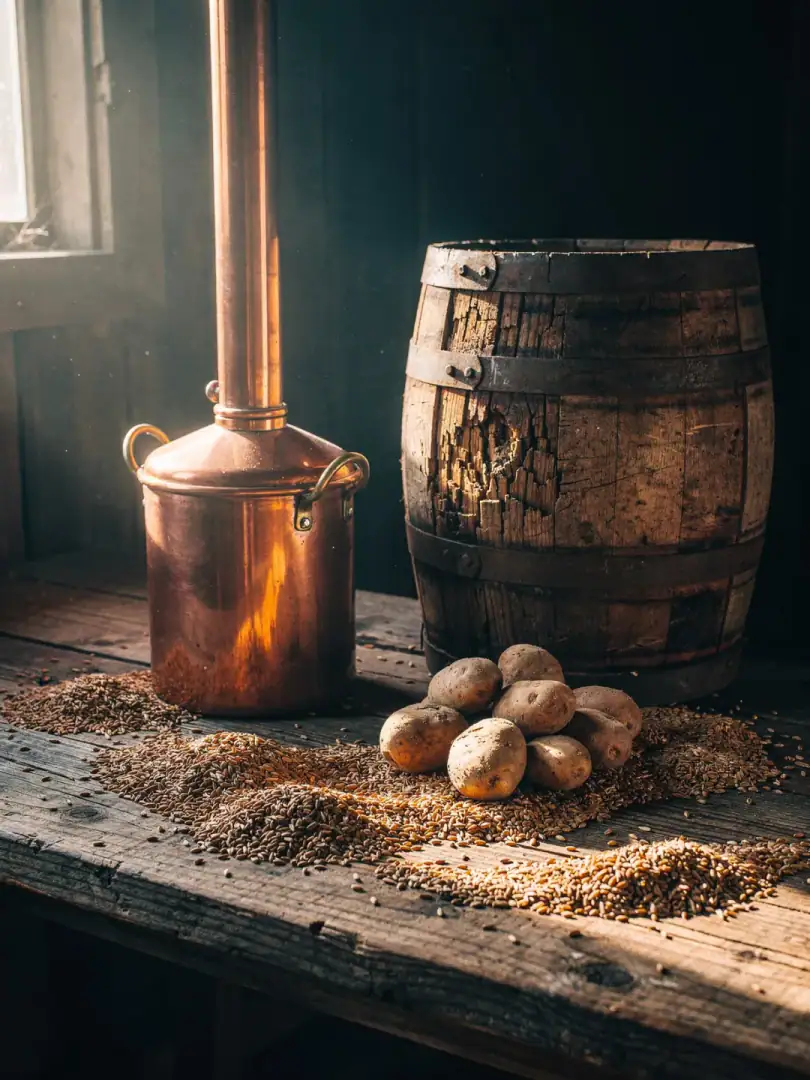
From the 16th century, large estates in Poland, Lithuania, and Russia developed their own estate distilleries, often built right next to the grain stores. They processed rye and wheat, and from the 18th century increasingly potatoes, which were cheaper to grow and yielded more per acre. For many noble families, distilling became the most important source of income alongside farming itself, with some estates relying almost entirely on alcohol sales. Quality varied widely from estate to estate, which is why individual names and places of origin established themselves early on as marks of quality, a forerunner of today's branding.
Criticism, Resistance, and Early Limits
The privilege didn't go unchallenged. Church reformers decried the widespread drunkenness among the rural population, while enlightened voices in the 18th century criticized the economic dependence of peasants on the manorial tavern. Individual rulers tried at times to restrict alcohol sales or tax them more heavily, but usually failed against the resistance of a nobility unwilling to jeopardize its income. Only with the gradual abolition of serfdom in the 19th century, in Russia in 1861, did the right of propination lose its economic foundation.
The Legacy of the Estate Distilleries
Even after the noble privilege ended, the infrastructure of the estate distilleries survived, passing in many places into private or cooperative hands. The divide between cheap, simple mass-produced spirit and carefully made estate produce, already built into the old noble privilege, still echoes today in the distinction between industrial and craft vodka. As the old order faded, states themselves increasingly took control of alcohol production, a development that reached its peak in the late 19th century and shapes the next stop on this journey.
The Potato Changes the Recipe
The potato only arrived in Europe from the Americas in the 16th century and spread slowly at first. It wasn't until the 18th century that it became a staple food in Poland, Russia, and parts of Germany. For estate distilleries, this was a stroke of luck. Potatoes grew even on poor soil, needed little care, and delivered more starch per hectare than grain. That meant significantly more spirit from the same amount of land.
The switch to potatoes also changed the flavor. Potato spirit tastes rawer and earthier than grain spirit, and was therefore initially held in lower regard. Only improved distilling and filtering techniques in the 19th century made a pure, neutral potato vodka possible. To this day, the debate between grain and potato vodka is seen in some countries as a matter of quality. For estate owners in the 18th century, though, yield mattered far more than finesse in the glass.
Not every estate owner switched to potatoes at the same pace, as many peasants initially distrusted the new crop out of superstition. Only targeted promotion by individual rulers, who mandated its cultivation on their own estates, noticeably sped up its spread. Within a few decades, though, the potato had established itself as a reliable foundation for distilling, especially in years of poor grain harvests.