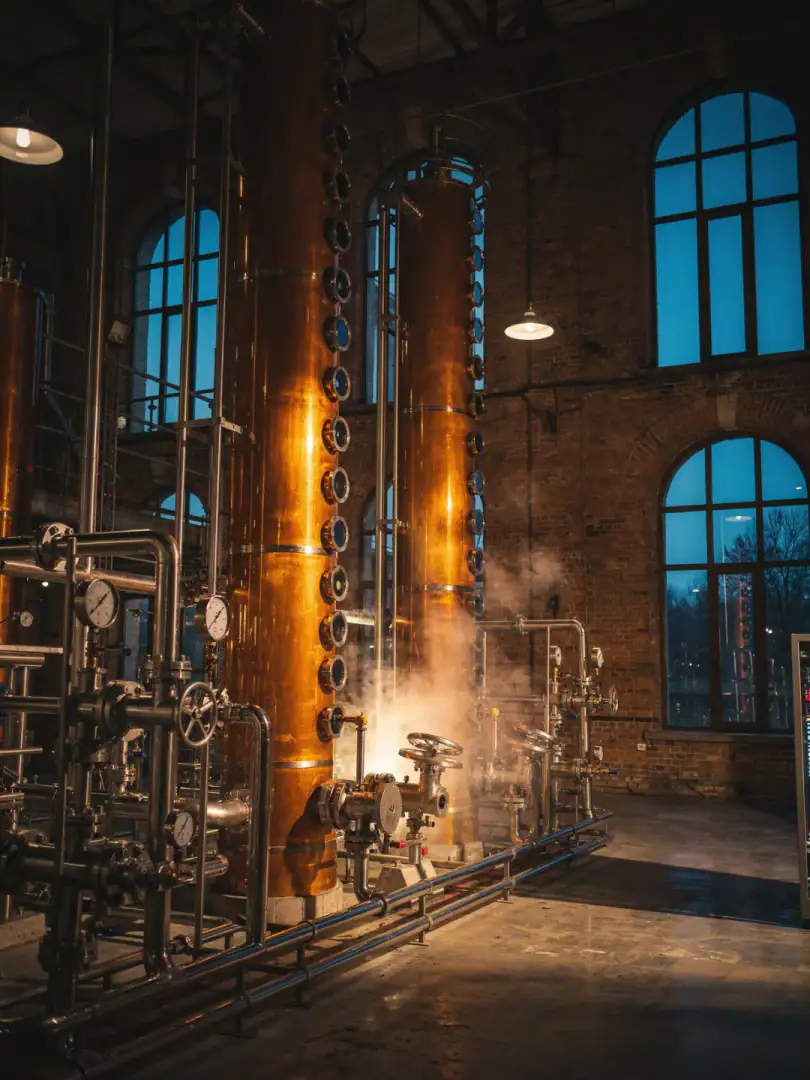
A Column Made from Wheat
Distilling & Rectification
Wheat doesn't turn straight into vodka. First, the starch in the grain has to become fermentable sugar. To do this, the milled grain is mixed with water from the region's wells to form a mash. Malt enzymes break down the starch, then yeast is added. Within a few days, it ferments the sugar into a weak, cloudy base beer.
This base beer has little more than eight to ten percent alcohol and tastes like nothing anyone would want to drink. Only column distillation turns it into a neutral spirit. In tall, tiered columns made of copper and stainless steel, the alcohol vapor rises through dozens of plates. With each stage it grows purer, until in the end a fine spirit emerges at well over ninety percent alcohol.
This is the crucial difference from whisky or Cognac. Vodka is specifically meant to lose all character of its raw material, becoming instead a clean, neutral carrier. Even so, with wheat, a hint of mild sweetness survives. That's exactly why Princess Shcherbatova chose this grain in the first place, back in 1872.
To make it drinkable, the fine spirit is then diluted with water to bottling strength. EU Spirit Drinks Regulation 2019/787 sets the minimum for vodka at 37.5% ABV. In practice, the industry bottles almost everywhere at forty percent, a figure that has barely changed in decades.
Exactly how many times a distillery rectifies its spirit usually remains a trade secret. The number of plates the vapor passes through is also rarely disclosed. One thing is certain: every additional stage makes the spirit purer, but also more neutral.
At the end of this chain stands the bottle. Nemiroff still fills it in Nemyriv today, following the same path from field to column that has existed here for a century and a half. Only the technology behind it has changed.