Birch Charcoal & Sand
Filtration
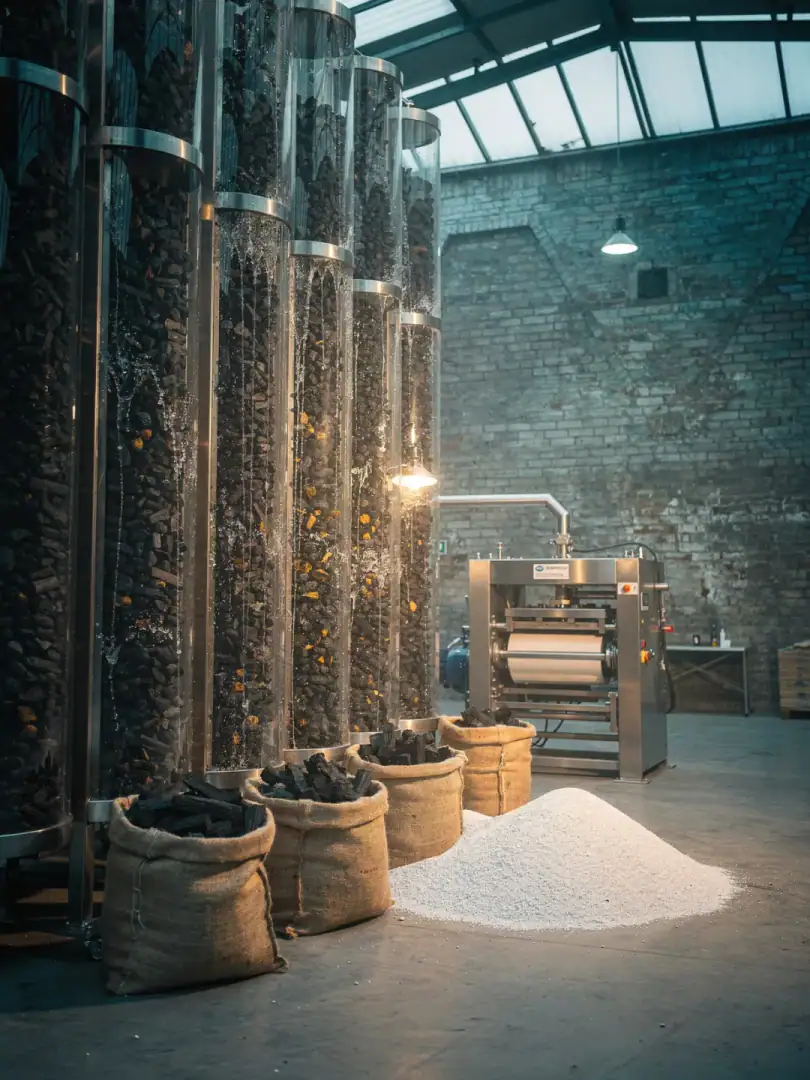
Even after rectification, traces of fusel oils and esters remain despite all the purity. The region's distilleries therefore filter once more, usually through columns of birch charcoal made from the wood of northern Ukrainian birch forests.
Birch charcoal binds organic residues to its porous surface. This genuinely makes the vodka taste cleaner, a measurable chemical effect, not a marketing gimmick. Alongside this, the alcohol often passes through layers of fine quartz sand, which holds back coarse particles before the vodka moves to the bottling line.
Some labels also tout silver filtration or silver ions in the water. Silver's antibacterial effect is well documented, but no one has yet independently proven a detectable taste difference in the finished vodka. This step is therefore seen more as a marketing point than a genuine technique. When it comes to flavor in the glass, birch charcoal and cold temperatures matter far more than any precious metal in the filter.
Cooling the alcohol to just a few degrees above freezing before filtering makes fusel oils and fatty acids more viscous, so they're more easily caught in the filter. This is the one step in the whole chain whose effect is beyond dispute. Afterward, the vodka feels less harsh to drink and rounder on the finish.
At the end of this chain sits an alcohol that is almost entirely neutral. The distillery's real signature barely survives into this final filtering step. What matters is the raw material and rectification, not the finishing touches that follow.
No label reveals how many filtering stages a distillery uses. The EU only mandates a minimum strength of 37.5 percent ABV, not the path taken to get there. Alongside birch charcoal, the facility near Khortytsia in Zaporizhzhia also uses quartz sand sourced from its own region.